MDF
The most common and affordable option, sold wrapped in a decor finish or primed white for painting. It swells with wet mopping, so it is a poor fit for kitchens, bathrooms and ground-floor units.
Finishing trims guide
At Pisos Pro Medellín we install floors in houses, apartments and shops around Medellín, and every job ends with baseboards and transition strips. This guide explains which piece goes where, and why.
After 900+ jobs over 15 years, we know a badly finished edge is the first thing a visitor notices, even when the floor itself is laid well. Here you will find the trim types, the materials and the expansion joints that cannot be skipped.
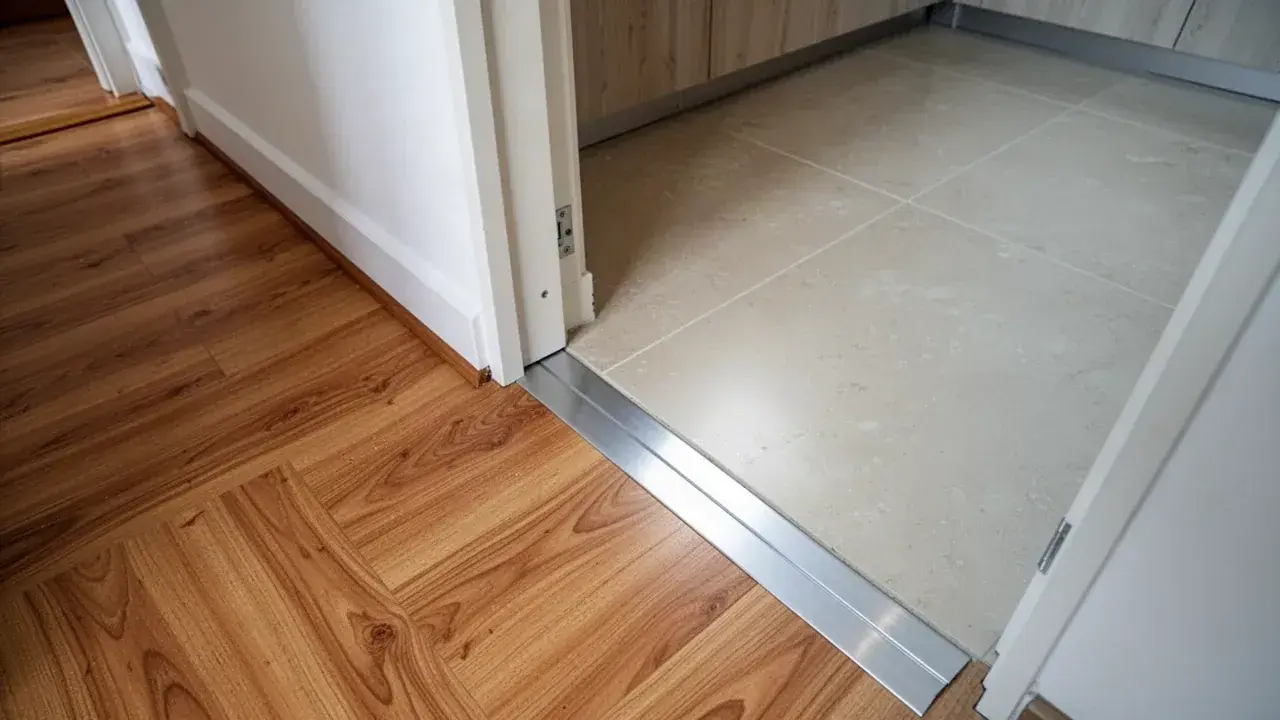
Aluminum strips stand up best to traffic; PVC or MDF wrapped in the same decor as the floor blends in more. For shop entrances and busy hallways we prefer anodized aluminum.
| Profile | Shape | When it is used |
|---|---|---|
| T-molding | A T-shaped piece covering the joint between two floors at the same height | Doorways between rooms, laminate meeting laminate or level porcelain tile, long runs that need a joint |
| Reducer or ramp | A sloped ramp stepping down from a higher floor to a lower one | 8 to 12 mm laminate meeting tile, glue-down vinyl or concrete |
| Stair nose | An angle that wraps around the edge of the step | Stairs and level changes in laminate or SPC; protects the edge and reduces slips |
| End cap or end molding | An L-shaped profile that closes the edge without joining another floor | Floor-to-ceiling windows, sliding doors, fireplaces or anywhere a baseboard will not fit |
| Threshold | A wide, flat piece under the door leaf | Front doors, balconies and terraces, where it also holds back dust and rainwater |
| Multi-purpose (3 in 1) | A fixed track with a cap that works as a T-molding, reducer or end cap | When the height difference is only known at the end, or one job has several situations |
In Medellín, installed baseboards (zócalos) cost COP $12,000 to $30,000 per linear meter depending on material and height. The most common heights run from 7 to 10 cm; a taller one hides an uneven wall better.
The most common and affordable option, sold wrapped in a decor finish or primed white for painting. It swells with wet mopping, so it is a poor fit for kitchens, bathrooms and ground-floor units.
Water does not affect it and it flexes, which helps on walls that are out of plumb. It is the sensible choice for kitchens, laundry areas and the damper houses of Eastern Antioquia.
It can be sanded, stained and painted, and it pairs well with solid or engineered hardwood. It costs more and must be sealed on every face before installation.
A slim, modern profile that shrugs off knocks from vacuums and cleaning carts. We use it in offices, retail spaces and minimalist apartments.
A floating floor behaves like a single sheet that moves with humidity and temperature. Joints split it into sections that move independently, and every joint gets its own strip.
Some SPC products allow longer runs without a strip because they expand less than laminate. That exception only applies if the technical data sheet states it in writing.
These defects show up at handover or appear in the first few months. Nearly all of them come from closing the expansion gap or fixing something to the floating floor.
If you already have loose strips or detached baseboards, our laminate and SPC floor repair service includes redoing those finishes.
Only if the edge is covered with an end cap, because the expansion gap must never be left visible. With neither baseboard nor end cap, that gap collects dust and exposes the plastic barrier.
Yes, when the new floor's gap can be covered with a thin quarter round glued to the existing baseboard. If the tile baseboard is very short and the laminate half buries it, it is better to remove it and fit a new one.
The usual approach is to match the darker of the two floors or go with natural aluminum, which suits almost anything. Between laminate and porcelain, matte aluminum tends to look cleaner than a wood-look PVC strip.
Standard reducers cover anything from a few millimeters up to about 1 cm. For bigger steps, it is better to level the lower floor or have a custom profile made.
On every flooring installation in Medellín we quote baseboards and transition strips as separate line items, so you know exactly what you are getting. If your new floor is laminate or includes stairs, we settle stair noses and trims during the site visit.
Pisos Pro Medellín
Tv. 6 #45-115, El Poblado, Medellín, Antioquia, Colombia
Monday to Saturday: 7:00 a.m. to 9:00 p.m.
Sunday: 9:00 a.m. to 9:00 p.m.