Rolled rubber and rubber tiles
Rubber flooring installation in Medellín
At Pisos Pro Medellín we install rolled and tile rubber flooring in places where other floors fail: ramps, daycares, veterinary clinics, balconies and wash areas. We are flooring specialists with more than 15 years and over 900 jobs in Medellín and its metro area.
We work for residential complexes (conjuntos), preschools, medical offices, shops and homes that need a floor that stays slip-resistant when wet, cushions falls and stands up to rough use. If your project is a gym or a sports court, see our sports and gym flooring page.
- Slip-resistant when wet
- Rolls and tiles
- Polyurethane adhesive
- 1-year warranty
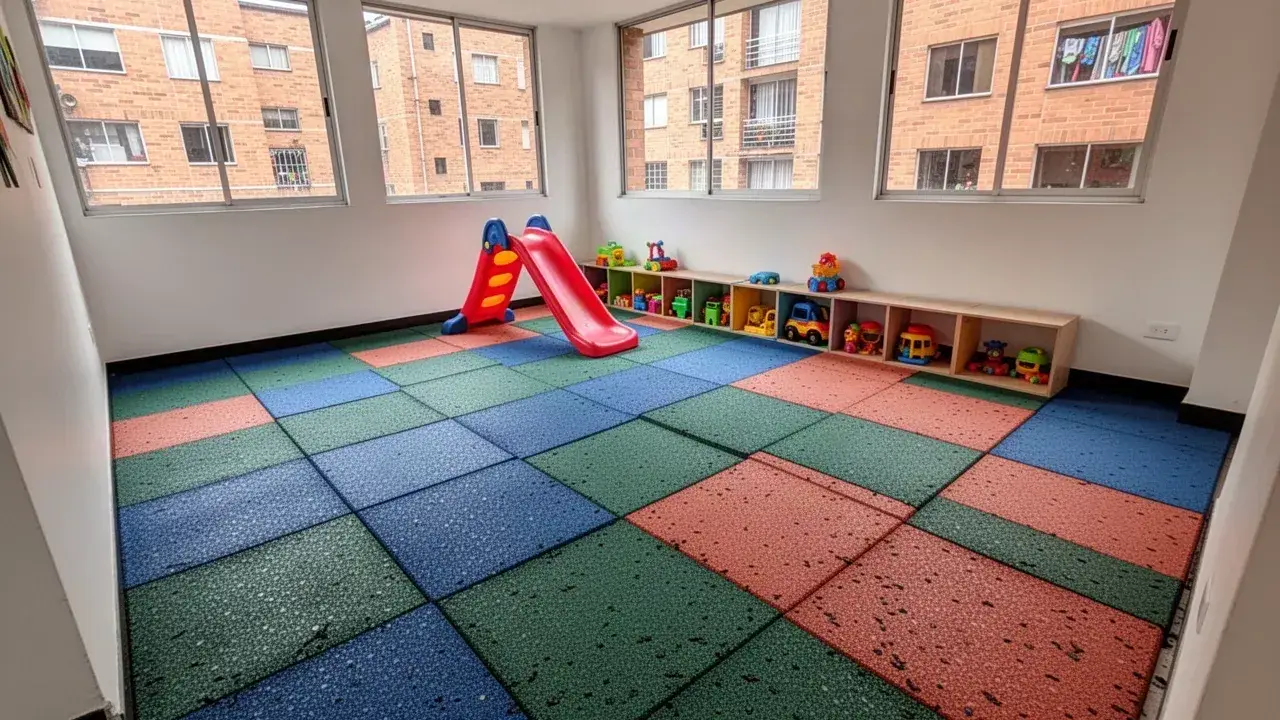
Rubber flooring for homes, businesses and wet areas
Rubber flooring starts from two raw materials. SBR is recycled tire rubber, black granules bound with polyurethane resin; EPDM is a colored synthetic rubber that holds up better in sun and has less odor.
Many products combine the two: an SBR base with EPDM color flecks or a top layer. For clinics and labs there is also vulcanized rubber, a dense, non-porous sheet that cleans like vinyl.
Installation includes a base assessment, leveling, gluing or interlocking, seam sealing and finishing at edges, ramps and drains.
Rolls, tiles and recycled rubber
Each format suits a different use, and the thickness changes with the impact and traffic it has to handle.
| Format | Typical thickness | Use | Installation |
|---|---|---|---|
| Recycled SBR rubber roll | 4 to 10 mm | Ramps, wash areas, utility rooms, vet clinics | Glued down with polyurethane adhesive |
| Vulcanized rubber sheet | 2 to 4 mm | Medical offices, labs, high-traffic corridors | Full-spread adhesive with sealed seams |
| Square SBR or EPDM tile | 15 to 40 mm | Play areas, daycares, terraces | Glued, or loose-laid with connector pins |
| Puzzle-style interlocking tile | 8 to 20 mm | Balconies, temporary areas, storerooms | Loose-laid, no adhesive |
In play areas, thickness is not about looks: European standard EN 1177 ties the thickness of an impact-absorbing floor to the critical fall height of the play equipment. That is why we ask the manufacturer for the tile's fall-height test before recommending it.
Where rubber works best
Rubber earns its keep where water, impact and heavy use come together, and it keeps its grip when wet far better than glazed ceramic or polished porcelain. These are the spaces where we install it most:
- Ramps and parking garages: coin-top or ribbed rolls, glued with polyurethane to withstand tires turning
- Daycares, preschools and residential complex playrooms: tiles that cushion falls and do not crack
- Veterinary clinics and pet grooming salons: a surface that stays grippy under wet paws, dampens noise and resists urine and disinfectants
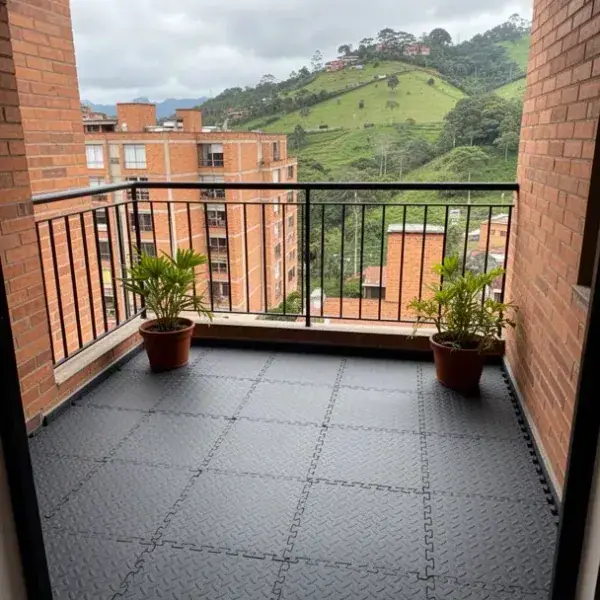
- Balconies, laundry areas and utility sinks: flooring that drains, does not turn slick with soap and feels warm underfoot
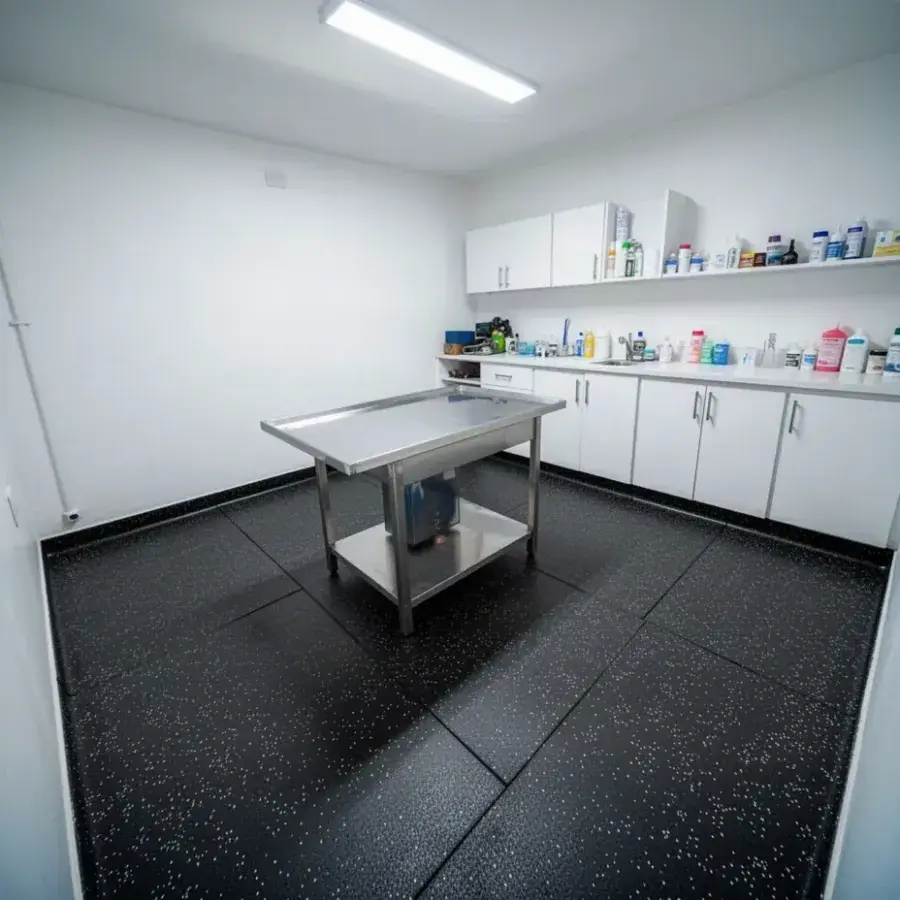
Glued-down vs. loose-laid rubber
Glued-down rubber is bonded across its full surface with polyurethane adhesive, two-part when there is constant water or vehicle traffic. It stays put, seams do not open and dirt cannot work its way underneath.
Loose-laid rubber rests on the base without adhesive: interlocking tiles or thick tiles joined with pins. It suits balconies where you do not want to disturb the waterproofing, temporary areas and leased shops that must be returned as they were found.
The rule of thumb: if wheels roll over it, water hits it every day or hygiene is required, glue it. If it has to be removable or water must run underneath to a drain, lay it loose.
Odor, ventilation and emissions
Recycled SBR rubber has a distinctive new-tire smell, strongest in the first days and in closed, warm rooms. With cross-ventilation it fades noticeably within one to three weeks.
For children's bedrooms, medical offices or windowless rooms we recommend EPDM or vulcanized rubber, which smell far less. If emissions are a project requirement, ask for products with a low-emission certification such as FloorScore.
While the smell fades, keep doors and windows open and avoid sealing the room with air conditioning that does not bring in fresh air.
Rubber flooring price per m²
2026 reference ranges in Medellín, in Colombian pesos and subject to the site visit.
The biggest price drivers are thickness (a 40 mm play-area tile costs several times what a 6 mm roll does), the type of rubber and the adhesive. The two-part polyurethane that ramps require costs more than a one-part adhesive, but it is the one that holds.
| Item | Reference range |
|---|---|
| Rubber material (rolls or tiles) | COP $70,000 to $190,000 per m² |
| Installation labor | COP $15,000 to $30,000 per m² |
| Total installed | COP $90,000 to $220,000 per m² |
| Self-leveling compound (if needed) | COP $35,000 to $75,000 per m² |
How we install rubber flooring
- 1
Cleaning and assessment
We strip grease, loose paint and dust, and measure moisture. Polyurethane does not bond well to contaminated or damp bases.
- 2
Leveling
We patch holes and dips with repair mortar or self-leveling compound. If the base is badly deteriorated, it first goes through our floor and subfloor repair service.
- 3
Relaxing the roll
We unroll the rubber on site and leave it flat for at least 24 hours so it loses the curl from packaging and adjusts to the room temperature.
- 4
Gluing or interlocking
We spread adhesive with a notched trowel and set the rubber with a roller, or assemble the tiles locked together with their pins or puzzle edges.
- 5
Seam sealing and handover
We seal seams wherever there is water or a hygiene requirement and finish edges, ramps and drains with trim profiles. We respect the adhesive's cure time before allowing vehicle traffic, then hand over with a signed completion record.
Rubber flooring FAQ
Is rubber flooring slip-resistant when wet?
Yes. Its granular or raised surface breaks up the film of water, and rubber has a natural grip with shoe soles and paws.
Smooth vulcanized rubber sheets are also safe when wet, though less so than textured ones. For ramps we always choose a textured finish.
Can rubber be installed on a balcony?
Yes, as long as the water has somewhere to go. We use loose-laid tiles with drainage channels underneath, or EPDM glued over waterproofing in good condition.
Black SBR handles the sun but fades over the years; EPDM keeps its color better. In a condominium building, check with building management (administración) if the change is visible from the facade.
How do you clean a rubber floor?
With water and pH-neutral soap, using a mop or a soft-pad floor machine. Avoid solvents, paint thinner, oils, waxes and petroleum-based cleaners, which swell rubber and make it tacky.
Veterinary clinics use disinfectants the manufacturer lists as compatible, followed by a clean-water rinse.
Can rubber be glued over ceramic tile?
Yes, if the tile is solid. We sand the glaze to open the surface, degrease it and use a primer compatible with polyurethane; over hollow tiles or deeply recessed grout lines, the base is corrected first.
For loose-laid interlocking tiles, the ceramic only needs to be clean and reasonably flat.
Get a quote for your rubber floor
Tell us where the floor goes and what traffic it gets; with that we propose the format, thickness and installation method, and book a free site visit.
The installation is backed by a 1-year workmanship warranty covering lifting, open seams and loose pieces caused by poor adhesion.
Pisos Pro Medellín
Tv. 6 #45-115, El Poblado, Medellín, Antioquia, Colombia
Monday to Saturday: 7:00 a.m. to 9:00 p.m.
Sunday: 9:00 a.m. to 9:00 p.m.