Floating over acoustic underlayment
Planks lock together with a click system or glued tongue and groove, resting on dense foam or cork underlayment. It is the fastest route and the one that best dampens footstep noise for the neighbor below.
Real wood, stable core
Pisos Pro Medellín is a company that does flooring and nothing else, with more than 15 years and over 900 jobs across the Aburrá Valley and Eastern Antioquia. We install engineered hardwood in apartments, houses, medical offices and workplaces.
This floor has a top layer of genuine wood, called the wear layer, bonded to a cross-ply core that holds movement in check. It is what we recommend to anyone who wants real oak, walnut or teak without the swelling risk that solid boards bring in a city with two rainy seasons a year.
Our own crew inspects the subfloor, installs the floor floating or glued down, and hands it over with transition strips, baseboards and a 1-year labor warranty.
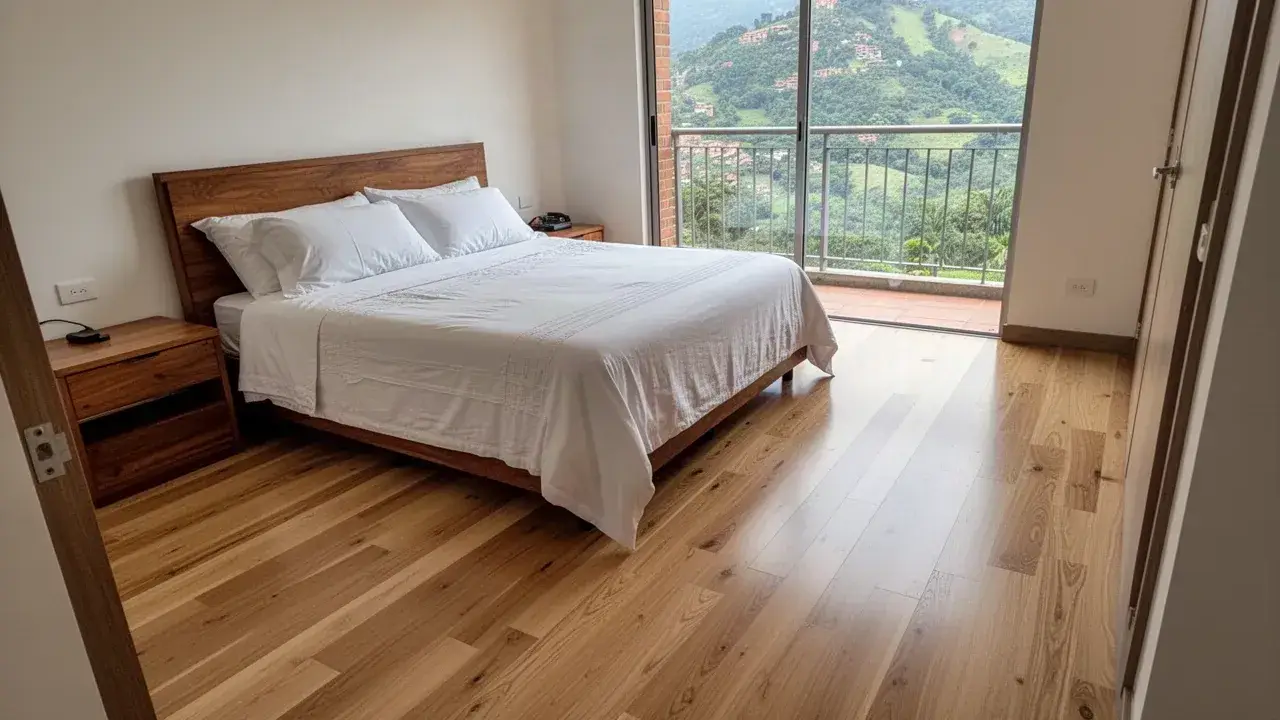
Each plank is a sandwich: on top, 2 to 6 mm of hardwood with a factory-applied lacquer or oil; underneath, multi-ply plywood or a three-layer board with the grain crossed at 90 degrees. Those opposing grain directions are what keep the plank still when the air changes.
The service covers the visit, the subfloor moisture reading, the underlayment or adhesive, installation, transition strips, baseboards and final cleanup. There is no sanding or finishing on site, because the finish comes already applied.
That is why a 60 to 80 m² apartment is ready in 3 to 5 days, compared with the 8 to 12 needed for solid hardwood finished in place.
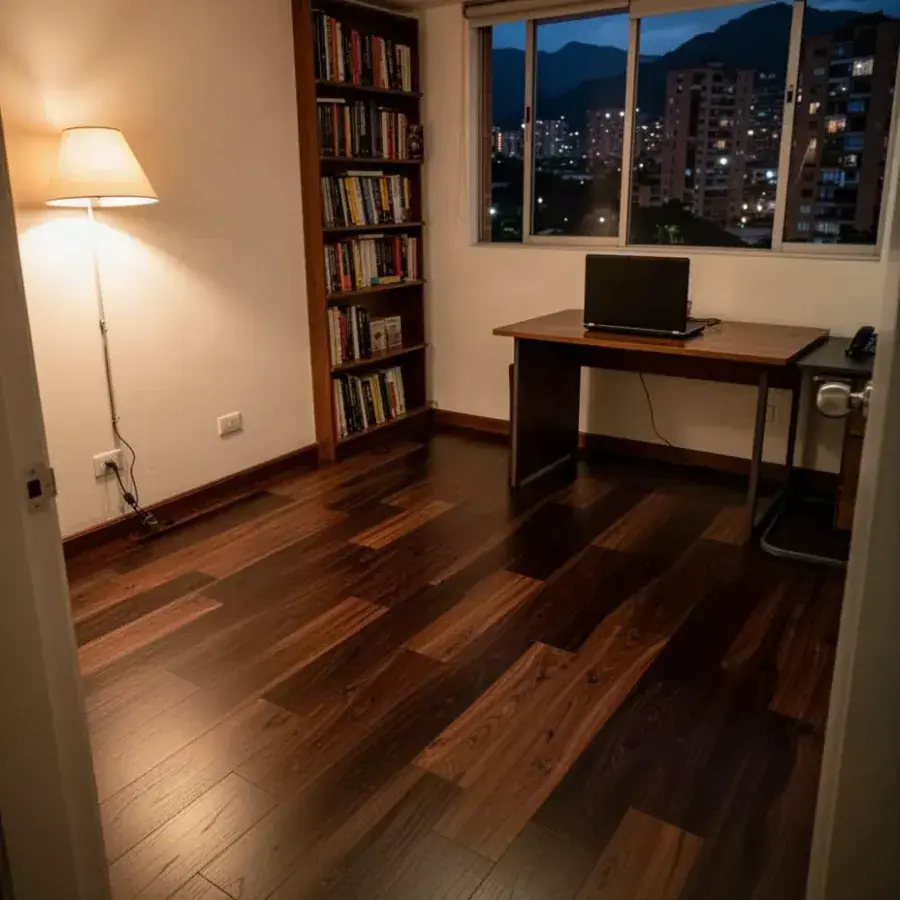
In the showroom, two boxes with the same photo can have very different lifespans. Ask for the technical data sheet and check these three specs before comparing prices.
| Spec | Option | What it means for you |
|---|---|---|
| Wear layer | 0.6 to 1.5 mm | Thin veneer: cannot be sanded, only recoated |
| Wear layer | 2 to 3 mm | One full sanding over its life |
| Wear layer | 4 mm | Two or three sandings; a good choice for a family home |
| Wear layer | 6 mm | Up to four or five sandings; performs almost like solid wood |
| Core | Multi-ply plywood | The most stable, and the best match for radiant heating |
| Core | Three-layer (lamella) core | Stable and lighter; common in wide planks |
| Core | HDF | Cheapest, but suffers if water reaches the edges |
| Total thickness | 10 to 15 mm | Easy to float over existing tile |
| Total thickness | 15 to 21 mm | Stiffer; can be nailed over sleepers |
Planks lock together with a click system or glued tongue and groove, resting on dense foam or cork underlayment. It is the fastest route and the one that best dampens footstep noise for the neighbor below.
Laid in elastic MS polymer adhesive over a flat, dry slab. It feels firm underfoot, without the slight give of a floating floor, and it is the right technique over radiant heating.
For houses with a wooden upper floor or country homes in Eastern Antioquia where a frame already exists. It requires planks 15 mm thick or more.
Many condominium bylaws (propiedad horizontal) require acoustic underlayment under hard floors and limit work hours. Check with building management (administración) before choosing; our guide to building rules for floor renovation sums up the usual requirements.
Wood expands far more across the grain than along it. In an engineered plank each core layer is turned relative to the one above, so when the wear layer tries to expand, the core holds it back.
In practice that means seams that do not open in January or lift in October. We still leave an 8 to 10 mm expansion gap around the perimeter, because the floor is still wood.
We recommend it for ground floors, apartments near streams (quebradas) and houses in Rionegro, La Ceja or Llanogrande, where cold, damp nights punish solid boards. Our guide to humidity and floors in Medellín explains how to read those conditions.
When we are called to inspect an engineered floor that failed, we almost always find one of these causes:
Over electric heating, the plank is fully glued and the thermostat is set so the surface never exceeds the manufacturer's limit, in most cases 27 °C (about 81 °F). We coordinate that installation with our radiant floor heating service.
Over existing tile, it can go in without demolition if the tile is sound and flat. We tap every piece with a rubber mallet to find hollow spots and confirm there is no more than 3 mm of deviation under a 2 m straightedge.
Loose tiles are re-bonded and deep grout lines are filled before the underlayment goes down. That way the plank never flexes over a void and starts creaking with time.
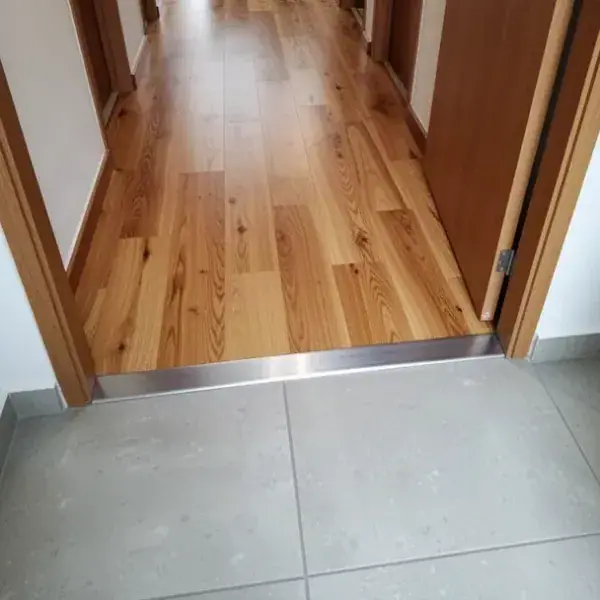
In Medellín in 2026, installed engineered hardwood ranges from COP $180,000 to $380,000 per m². That combines material at $140,000 to $320,000 and labor at $40,000 to $65,000; the exact figure comes out of the site visit.
| Factor | Lowers the cost | Raises the cost |
|---|---|---|
| Wear layer | 2 to 3 mm | 4 to 6 mm |
| Species and grade | Rustic-grade oak with knots | Walnut or select oak without knots |
| Factory finish | Standard UV lacquer | Natural oil or hand-scraped |
| Format | Narrow, short planks | Wide planks longer than 1.8 m |
| Installation | Floating over sound tile | Glued after self-leveling |
We measure the rooms, inspect the tile or slab, take a subfloor moisture reading and decide between floating and glue-down.
The unopened boxes sit in the apartment for 48 to 72 hours so they reach room temperature.
For floating floors, 200-micron polyethylene with taped overlaps plus acoustic underlayment; for glue-down, adhesive spread with a notched trowel.
We mix planks from several boxes to blend the color and keep the perimeter gap at walls, columns and pipes.
We fit transitions to bathrooms and kitchen, install baseboards and haul away offcuts and packaging.
We walk the floor with you, sign the completion record (acta) and leave cleaning instructions with products made for finished wood.
Engineered flooring has a layer of real wood you can touch, smell and, if it is thick enough, sand. Laminate flooring is a printed photo of wood over HDF, cheaper and more scratch resistant, but it cannot be renewed.
Yes, if the wear layer allows it. A 2 to 3 mm layer takes one sanding, 4 mm takes two or three, and 6 mm up to four or five over its life.
A hollow sound appears when the underlayment is thin or the subfloor is uneven. We use high-density acoustic underlayment and correct the subfloor so the plank is supported across its whole surface.
Message us on WhatsApp, call, or fill in the form. We schedule a free visit and send you an itemized written quote.
The installation is backed by a 1-year labor warranty, on top of the manufacturer's warranty on the product itself.
Pisos Pro Medellín
Tv. 6 #45-115, El Poblado, Medellín, Antioquia, Colombia
Monday to Saturday: 7:00 a.m. to 9:00 p.m.
Sunday: 9:00 a.m. to 9:00 p.m.