Slabs, subfloors and screeds

Concrete flooring installation in Medellín

At Pisos Pro Medellín we build concrete floors that do real work: slabs on grade, concrete subfloors (contrapiso) and leveling screeds that later receive another finish. We are flooring specialists with more than 15 years of experience and over 900 completed jobs across the Aburrá Valley and Eastern Antioquia.

Our clients include warehouses, parking areas in residential complexes, home garages, retail spaces and country houses in Rionegro and Llanogrande. A good concrete floor is decided before the pour: base, thickness, reinforcement, joints and curing.

Below we walk you through how we build it and what each step prevents. If you are after the diamond-ground, glossy finish instead, see our polished concrete service.

  • 3,000 to 4,000 psi concrete
  • Joints saw-cut the same day
  • Minimum 7-day cure
  • 1-year labor warranty
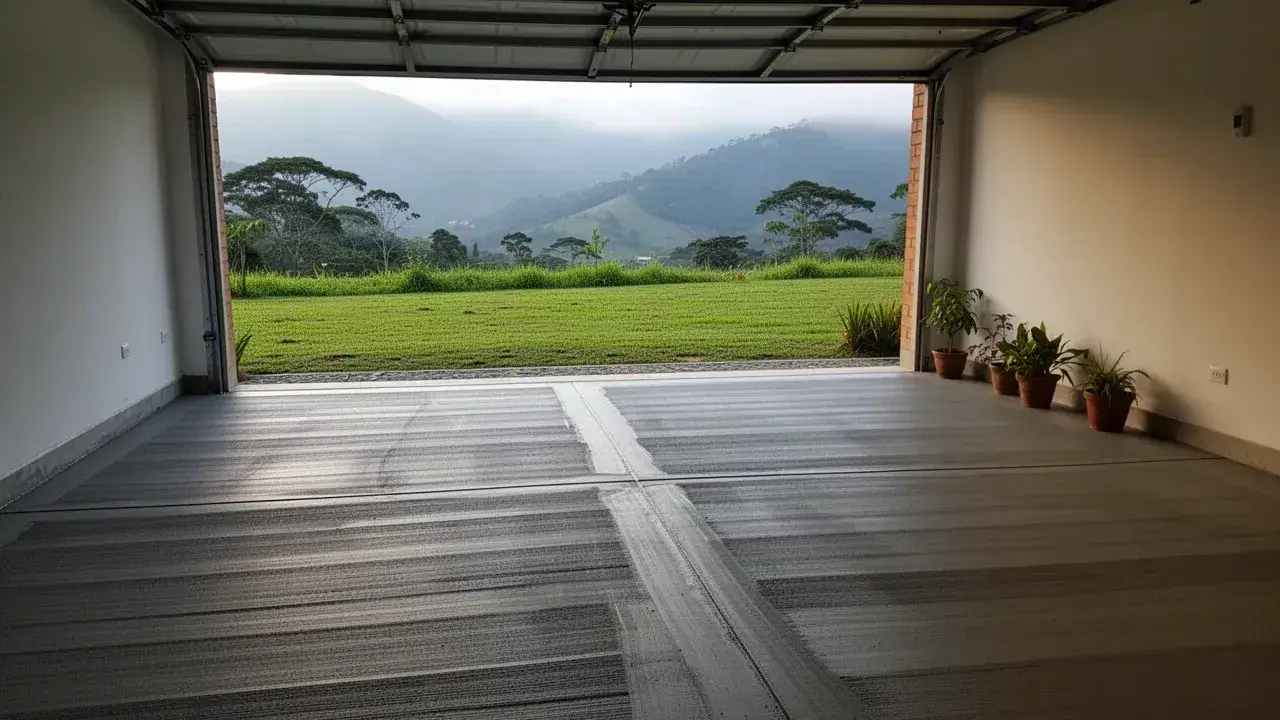
Broom-finished concrete floor in a country house garage

Concrete floors for warehouses, garages, homes and shops

The service covers preparing the ground or the existing slab, formwork, reinforcement, the pour, surface finishing, joint cutting and curing. You get a floor that is ready to use or ready to take another material on top.

We order ready-mix concrete at the specified strength and check the slump with an Abrams cone before the truck unloads. Adding water on site so the mix flows more easily is the most common cause of weak, dusty floors, and we do not allow it.

Jobs range from 30 m² garages to warehouses of several hundred square meters, poured in panels so we control where the cold joints fall.

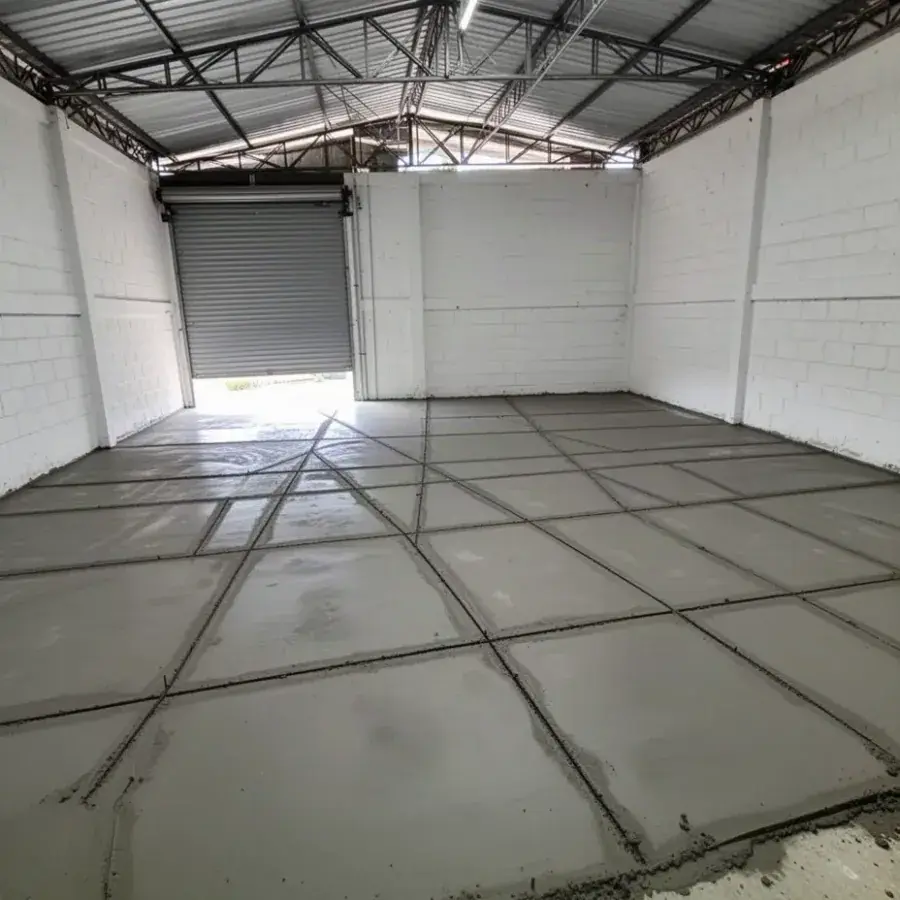
Concrete slab with saw-cut control joints in warehouse

Slabs on grade, concrete subfloors and screeds

Slabs on grade

These rest directly on the soil, so the work starts below: stripping the topsoil, a granular base compacted in lifts with a plate compactor, and a polyethylene sheet against ground moisture.

The wire mesh sits centered in the slab thickness on chairs or concrete spacers. Trampled down onto the ground, as you see on many sites, it does nothing at all.

Concrete subfloors (contrapiso)

This is the concrete layer, usually 5 to 8 cm thick, poured over a structural slab or prepared ground to set the final floor level. It later receives tile, wood, SPC or a coating, and its flatness defines the quality of the floor above.

Screeds and leveling mortar

To correct 2 to 5 cm we use sand and cement mortar over a bonding agent, not concrete with gravel. For just a few millimeters over a sound base, a cementitious self-leveler is the better choice, at COP $35,000 to $75,000 per m².

Concrete strength, reinforcement and control joints

For homes and foot traffic we specify 3,000 psi (21 MPa) concrete. Garages, parking areas and warehouses with manual pallet jacks move up to 3,500 or 4,000 psi (24 to 28 MPa), and with forklifts the design is done by an engineer.

The usual reinforcement is welded wire mesh with tied laps. Polypropylene fiber controls plastic shrinkage cracks in the first hours, but it does not replace the mesh where vehicles drive.

All concrete shrinks as it dries and will crack; control joints decide where. We saw-cut them to a quarter of the slab depth 6 to 18 hours after the pour, in nearly square panels of about 3 to 4 m for a 12 cm slab.

If the slab is structural (an upper floor, a slab over a basement or a vehicle ramp), its design belongs to a civil engineer under Colombia's seismic building code, the Reglamento Colombiano de Construcción Sismo Resistente NSR-10. We build the floor to that design and never stand in for the calculation.
Finishes: troweled, broomed, hardened and stamped

The finish is chosen before the pour, because it changes the crew, the equipment and the moment to trowel. For patios in Eastern Antioquia, where it rains much of the year, we recommend a broom finish or stamped concrete with a non-slip sealer.

Concrete floor finishes and where they work
FinishRecommended useAppearance
Power troweledWarehouses, covered garages, base for epoxySmooth gray with a light sheen
Broom finishRamps, patios, sidewalks and open garagesLined texture that grips in the rain
Dry-shake quartz hardenerWarehouses with pallet jacks, workshops, parking areasDense surface, gray or colored
StampedCountry house driveways, terraces, outdoor living areasImitates stone, pavers or wood, with sealer
Rough or scoredSubfloor that will receive ceramic or porcelain tileCoarse, designed for mortar bond

Curing: the step that prevents cracks

Concrete that loses water too fast ends up with a weak surface that dusts and develops spiderweb cracking. Midday sun in Medellín and wind on open patios can dry the exposed face within a few hours.

We cure for at least 7 days using one of two methods: a curing compound sprayed on as soon as the bleed water sheen disappears (products such as Sika's Antisol), or continuous wetting under plastic or damp burlap.

On strong sun days we pour early in the morning and shade the area with mesh while it sets. If the floor will later get an epoxy coating, the curing compound must be compatible or ground off, and we define that in the quote.

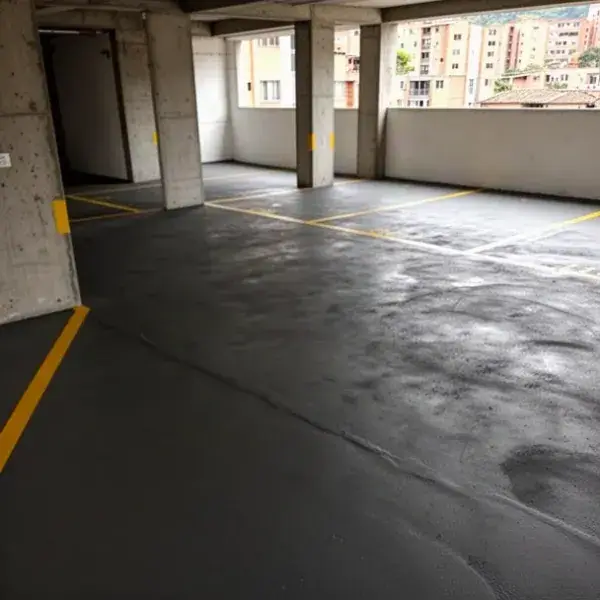
Dark gray hardened concrete floor in a parking garage

Slab moisture before another floor goes on top

Fresh concrete holds far more water than it needs to set, and it releases it over weeks. As a practical rule, a slab needs about a month per 2.5 cm of thickness to dry in good conditions, and longer in the rainy season.

Installing wood, laminate, glue-down vinyl or epoxy over a damp slab leads to swollen boards, adhesives that fail and blisters. That is why we take moisture meter readings at several points, not just the center, before scheduling the finish floor.

When you cannot wait, the answer is an epoxy moisture barrier or an underlayment membrane, depending on the material going on top.

Concrete floor cost per m²

A new concrete floor or slab in Medellín costs COP $120,000 to $220,000 per m² installed, including materials, labor, reinforcement, joint cutting and curing. Quotes are in Colombian pesos, and the final price is confirmed at the site visit.

To compare against other materials, check our Medellín flooring price guide.

2026 reference ranges in Medellín (COP)
FactorHow it affects the price
ThicknessA 15 cm slab uses almost twice the concrete of an 8 cm subfloor
ReinforcementSingle mesh, double mesh or structural fiber depending on the load
BaseExcavation, fill and compaction add cost on unprepared lots
FinishStamped and hardened finishes cost more than a plain trowel finish
AccessIf the mixer truck cannot reach, concrete is pumped or moved by wheelbarrow
AreaSmall areas pay a minimum charge for mix and delivery

How we build a concrete floor

  1. 1

    Site visit and layout

    We measure, shoot levels with a laser level and set the slope toward drains, 1 to 2% in garages and patios.

  2. 2

    Base and vapor sheet

    We compact the granular base in lifts and lay lapped polyethylene under slabs on grade.

  3. 3

    Forms and reinforcement

    We set forms to level, place the mesh on chairs and install dowels at construction joints that carry vehicle traffic.

  4. 4

    Pour and consolidation

    We receive the concrete with a slump check, vibrate it and strike it off with a vibrating screed.

  5. 5

    Surface finishing

    We power trowel, broom or stamp when the concrete reaches the right set, never too early or too late.

  6. 6

    Joints, curing and handover

    We saw-cut joints the same day, apply the cure and hand over with a signed completion record and day-by-day use instructions.

Concrete flooring FAQs

How long should concrete cure before I use it?

You can walk on it carefully after 24 to 48 hours. Light cars can drive on it at 7 days, and trucks or forklifts at 28 days, when the concrete reaches its design strength.

Those times assume continuous curing. Without curing, the concrete never reaches the strength you paid for.

Why does a new concrete floor crack?

The causes we see most are shrinkage with no joints, joints cut the next day (after the slab has already cracked on its own) and poor curing. Next come a badly compacted base and water added on site.

Fine shrinkage cracks are usually not structural. Cracks that keep opening or have an offset between edges point to a base problem and are assessed through our floor and subfloor repair service.

How thick does a garage floor need to be?

For a home garage with light cars on well-compacted ground, 12 to 15 cm with welded wire mesh and 3,500 psi concrete is typical. With heavy pickups, buses or forklifts, an engineer sets the thickness and reinforcement based on the load and the soil.

If the garage sits over a basement, the slab is structural and is not altered without that design.

Can new concrete be poured over an old floor?

Yes, as a bonded overlay, as long as door and drain levels allow it. First we check that the old floor is not hollow or sunken, because new concrete copies the defects of its base.

Get a quote for your concrete floor

Send us the approximate area, the use (foot traffic, cars or forklifts) and photos of the site, and we will schedule a free technical visit. Your quote arrives in writing with every item broken out.

Every concrete floor we build carries a 1-year labor warranty; see what it covers on our warranty page.

Pisos Pro Medellín

Tv. 6 #45-115, El Poblado, Medellín, Antioquia, Colombia

info@pisosmedellin.com

Monday to Saturday: 7:00 a.m. to 9:00 p.m.

Sunday: 9:00 a.m. to 9:00 p.m.

Free quote