Material and thickness
The wood species, tread thickness and the porcelain or stone product account for most of the cost.
Treads, risers and handrails
At Pisos Pro Medellín we clad staircases in hardwood, laminate, SPC, porcelain and marble, and install handrails for houses, duplexes and shops in Medellín and its metropolitan area. We are flooring specialists with more than 15 years in the trade.
A staircase is the most demanding part of any floor job: every step is measured, cut and fitted by hand, and a 1 cm error is something you feel on the way up. We work for families remodeling two-story houses, owners of duplexes and penthouses in El Poblado, and businesses with high-traffic stairs.
With more than 900 completed jobs, we take care of what photos do not show: equal riser heights, solid nosings and well-anchored handrails. Everything comes with a 1-year labor warranty.
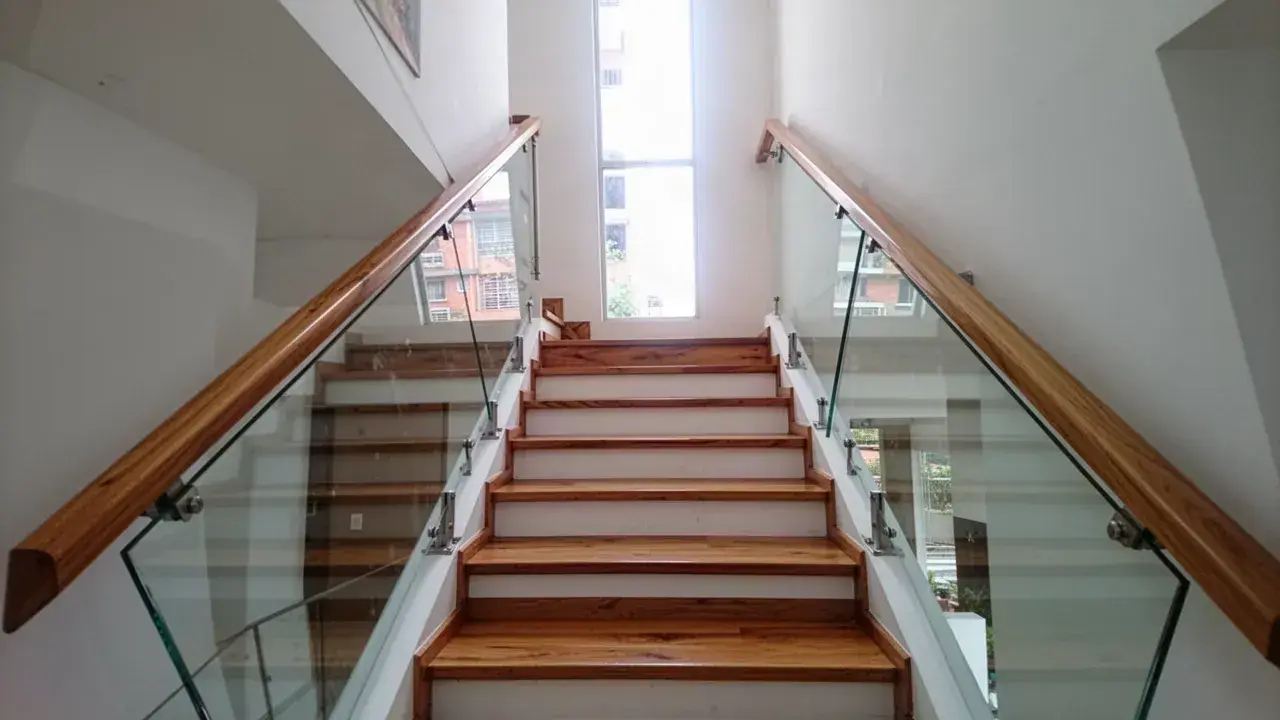
We cover the tread, the surface you step on, the riser, the vertical face, and the nosing, the front edge where nearly all falls happen. We also install handrails and balustrades, and tie the staircase visually to the floor on each level.
We work on concrete, steel-frame and wooden staircases: straight, L-shaped, U-shaped and spiral.
The staircase material should work with the floors around it. If your ground floor is solid hardwood flooring, the natural choice is a staircase in the same species; if it is SPC, we use treads in that same SPC with a matching nosing.
| Material | Look | Durability | Price per step |
|---|---|---|---|
| Solid hardwood | Warm; can be sanded and refinished | High, with treads 3 to 4 cm thick | COP $350,000 to $900,000 |
| Engineered hardwood | Same surface look as solid wood | Medium; thin wear layer limits resanding | Lower than solid wood |
| Laminate or SPC with nosing | Very realistic wood look | Good in homes; SPC tolerates water | Lower than wood |
| Porcelain stair tile | Modern, pairs with tiled floors | Very high, but the edge chips if badly cut | Lower than wood |
| Marble or granite | Elegant; granite for heavy traffic | High, with slip-resistant grooves | Similar to or above wood |
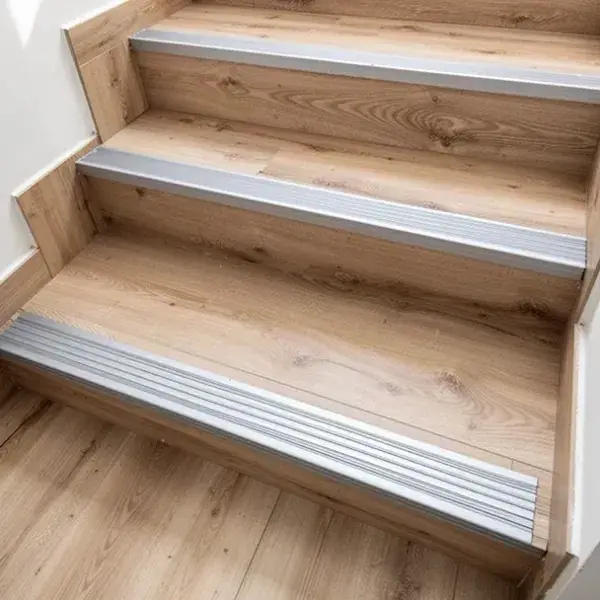
The nosing takes every footfall and knock; if it is weak, it splinters, comes loose or gets slippery. Each material has its own answer: a rounded solid-wood nosing for hardwood, a stair nose profile for laminate and SPC, a bullnose step tile for porcelain and routed grooves for marble.
The mistake we fix most often is laminate glued flush to the edge with no nosing. The board's core edge is left exposed, soaks up moisture, swells and breaks, and the smooth surface sends anyone in socks sliding down.
On commercial stairs, or in homes with children and older adults, we recommend an aluminum stair edge with a slip-resistant insert that can be replaced without removing the tread.
We install solid wood handrails, stainless or painted steel handrails, and laminated tempered glass railings held by clamps or a U-channel. Wood is sanded and lacquered to match the treads, and glass brings light into a narrow stairwell.
As a practical reference, the handrail sits 85 to 95 cm above the nosing and balusters are no more than 10 cm apart, so a child's head cannot fit through. Title K of Colombia's NSR-10 building code sets requirements for stairs and railings, and at the visit we check what applies to your case and what building management (administración) requires.
Anchoring is what makes a handrail safe, because it has to hold a person who suddenly leans on it. We fix it to the slab or wall with chemical or expansion anchors, never to the cladding alone.
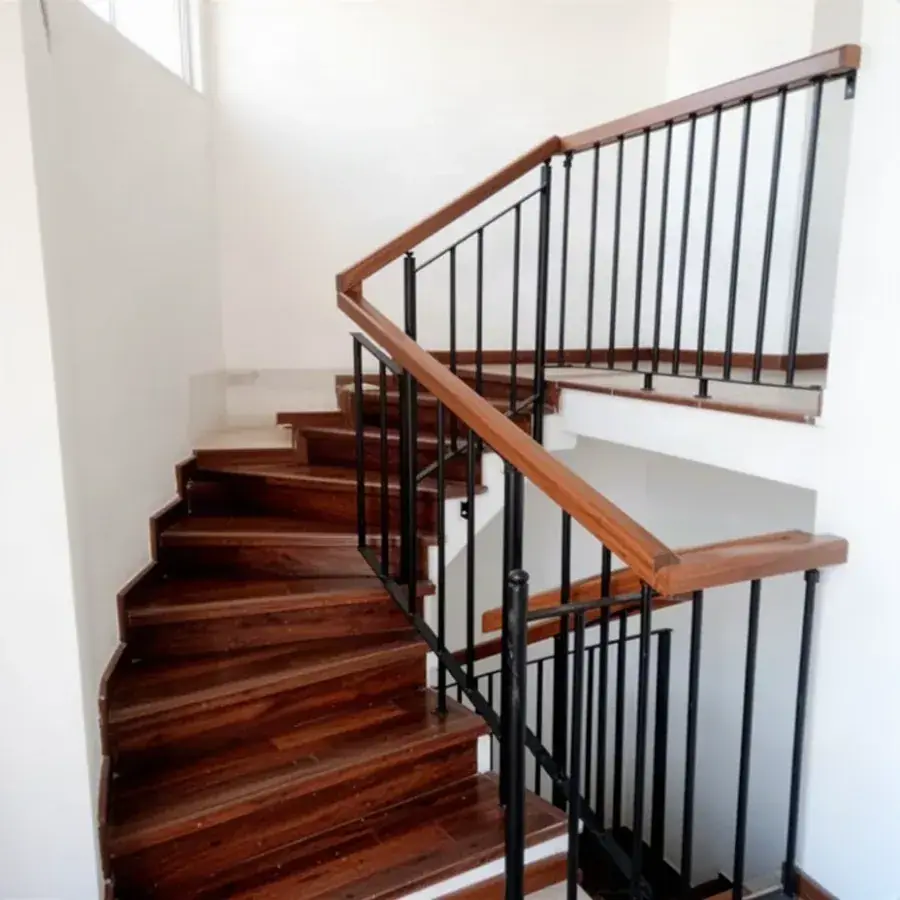
Older houses in Laureles, Belén or Envigado often have wooden stairs that squeak. The noise comes from treads that dried out and worked loose, nails that lost their grip or shims that fell out from under the step.
We diagnose it by walking each step and inspecting from below when there is access. It gets fixed with countersunk screws, polyurethane adhesive and new shims, before any cladding goes on.
We also look for termites (comején): wood that sounds hollow, fine powder or mud tubes on the stringers. If there is an infestation it gets treated first, as our guide to termites and carpenter ants explains, because covering infested wood only hides the damage.
A solid hardwood staircase costs COP $350,000 to $900,000 per installed step, and handrails COP $250,000 to $700,000 per linear meter. In laminate, SPC and porcelain a step usually comes in below wood, and in marble about the same or higher.
You can find other figures in our flooring price guide for Medellín.
The wood species, tread thickness and the porcelain or stone product account for most of the cost.
Straight stairs are the most affordable. L-shaped and U-shaped stairs have winder steps with angled cuts, and spiral stairs need an individual template for each tread.
Priced per linear meter depending on material, number of anchors and curves.
Correcting uneven risers, reinforcing loose wood or treating termites is added before cladding.
We measure the depth, width and height of each step, because on a concrete staircase no two are identical. We aim for two risers plus one tread to add up to 62 to 64 cm, the comfort rule architects use.
We strip the old finish and build up with mortar so every riser ends up the same height. If the floor below is not raised as much as the stairs, the first step ends up taller than the rest, a classic error that causes trips.
We cut treads and risers to fit each step and make templates for winders and spiral stairs.
We bond with polyurethane adhesive or C2 thinset depending on the material, always working from the bottom up. There is no such thing as floating laminate on stairs: every piece is glued down.
We fasten the nosings or edge trims and seal the joints with walls and baseboards.
We anchor handrails and railings, apply lacquer or sealer and hand over with a signed record and care tips.
Yes, on two conditions: each tread is glued to the step and the edge gets a nosing made for laminate. Without a nosing, the edge swells and breaks within a few months.
If the stairs are near a bathroom or an entrance where water gets in, we prefer SPC with a stair nose, which does not swell with moisture.
In solid hardwood, between COP $350,000 and $900,000 per step depending on species, thickness and shape. Laminate, SPC and porcelain usually come in lower, and the handrail is added per linear meter.
We give you the exact figure in writing after measuring every step at the visit.
Almost always because a loose tread rubs against the riser or stringer when you step on it. Over the years the wood dries, nails lose their grip and shims drop out.
The fix is to secure the tread with screws and adhesive, replace the shims and, if needed, reinforce the stringer. If the squeak comes with hollow-sounding wood or fine powder, we check for termites before touching anything.
A straight staircase of 14 to 16 steps in laminate or SPC takes 2 to 3 days; in solid hardwood with lacquer, 5 to 8 days. Glass or steel railings are made to measure and can add 1 to 2 weeks of lead time.
Book a free visit: we measure every step, check the structure and show you options for material, nosing and handrail. You receive a written quote within 24 to 48 hours.
Stair cladding and handrails carry a 1-year labor warranty against loose treads, detached nosings and slack anchors.
Pisos Pro Medellín
Tv. 6 #45-115, El Poblado, Medellín, Antioquia, Colombia
Monday to Saturday: 7:00 a.m. to 9:00 p.m.
Sunday: 9:00 a.m. to 9:00 p.m.