Slab moisture
Vapor rising from a damp slab pushes on the resin and forms liquid-filled blisters weeks later. You diagnose it by cutting a blister open: if there is water and the concrete is dark, moisture is the source.
Concrete floor coatings
At Pisos Pro Medellín we install epoxy floors and concrete coatings for warehouses, garages, clinics, laboratories, food plants and retail spaces. We are flooring specialists with more than 15 years of experience and over 900 jobs in Medellín, the Aburrá Valley and Eastern Antioquia.
A well-installed epoxy floor is seamless, waterproof, easy to wash and stands up to chemicals and forklifts. Installed badly, it blisters or peels within weeks, and the cause is almost always the concrete underneath.
That is why every project starts with a slab diagnosis: hardness, moisture, oil contamination and cracks. Only then do we recommend a system and thickness.
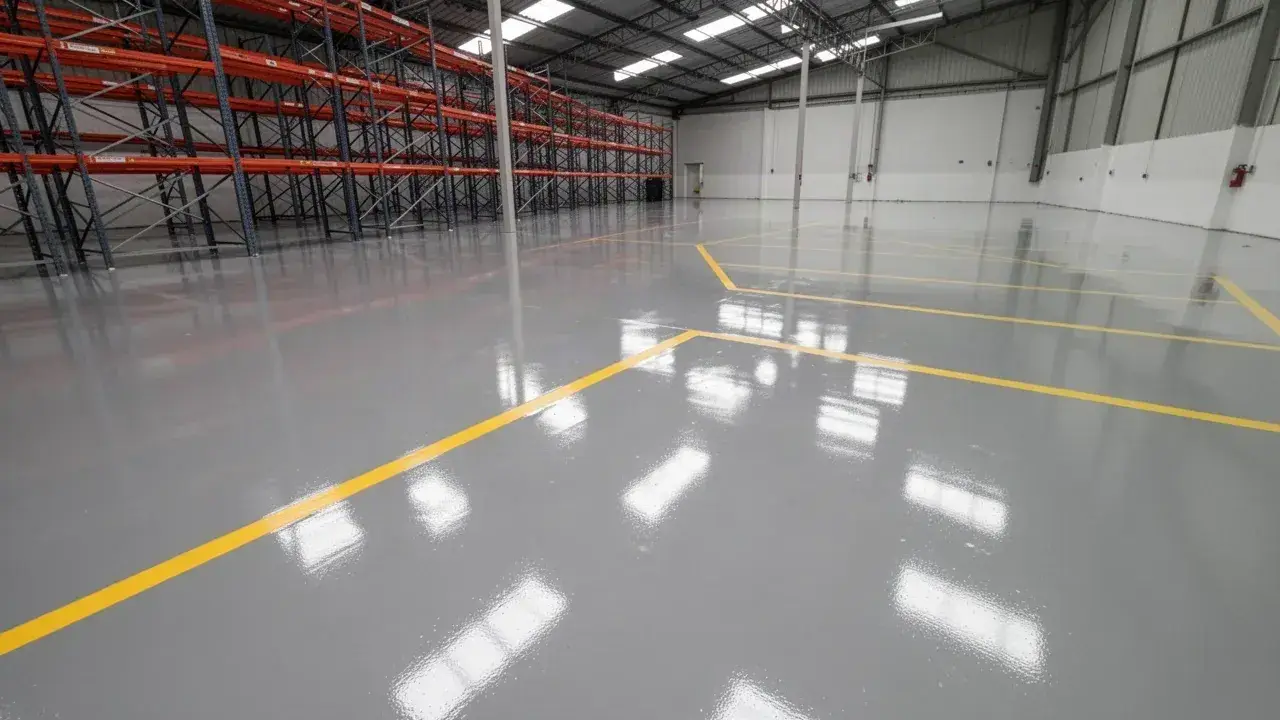
An epoxy coating is a two-part resin, base and hardener, that reacts chemically and forms a hard layer bonded to the concrete. Depending on thickness, it ranges from a high-solids paint to a mortar several millimeters deep.
Our scope covers diagnosis, mechanical prep, repairs, primer, system coats, line striping if needed, curing and handover with a maintenance sheet. We use systems from brands such as Sika (the Sikafloor line) and Pintuco (Pintucoat), chosen for how demanding the use is.
Projects run from home garages in Envigado to warehouses in Medellín and Rionegro. For company projects with several areas, see our commercial flooring page as well.
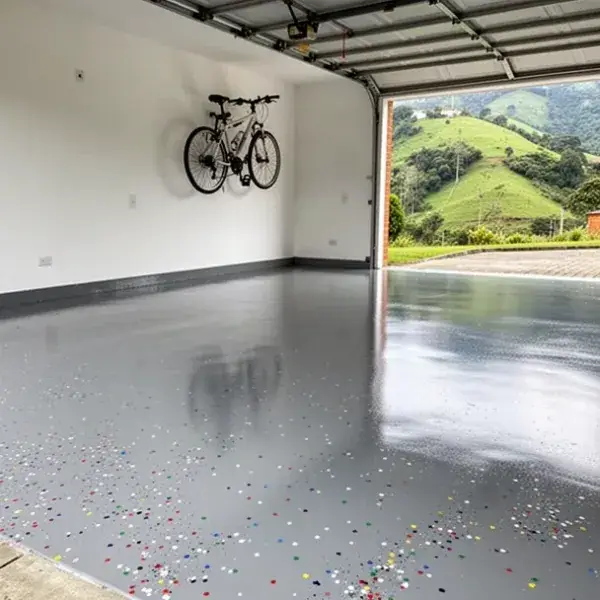
Data sheets measure thickness in mils: 1 mil is one thousandth of an inch, about 25 microns. Comparing quotes without comparing dry film thickness and number of coats means comparing different products.
| System | Typical thickness | Use | Expected service life |
|---|---|---|---|
| High-solids roller-applied epoxy coating | 0.2 to 0.4 mm (8 to 16 mils) in 2 coats | Garages, light-traffic warehouses, line striping | 2 to 5 years depending on traffic |
| 100% solids self-leveling epoxy | 2 to 3 mm | Warehouses, laboratories, clinics, production plants | 8 to 12 years with maintenance |
| Decorative self-leveler (porcelanato líquido) | 1.5 to 3 mm with topcoat | Shops, offices, showrooms | 8 to 12 years under foot traffic |
| Metallic or 3D epoxy | 2 to 3 mm | Design floors in shops, homes and showrooms | 8 to 12 years with a polyurethane topcoat |
| Troweled epoxy mortar | 4 to 6 mm | Workshops, ramps and impact zones | 10 years or more |
| Urethane cement | 6 to 9 mm | Commercial kitchens and food plants | 10 years or more |
Epoxy grips the open pores of the concrete. On a smooth troweled slab with laitance, dust or curing compound, the resin bonds to a weak skin and lifts off in sheets.
We prepare with a diamond grinder and vacuum to a CSP 2 to 3 profile per the ICRI 310.2R guideline, or with a shot blaster on large areas. The muriatic acid etching some still use does not leave an even profile and leaves salts in the pores.
Cracks are routed into a V and filled with epoxy mortar, control joints are honored and sealed with a semi-rigid filler, and oil is removed with degreaser and grinding.
Before priming we measure moisture, because most manufacturers require less than 4% in the substrate. If the concrete is damp, the system gets a moisture-tolerant primer or an epoxy moisture barrier.
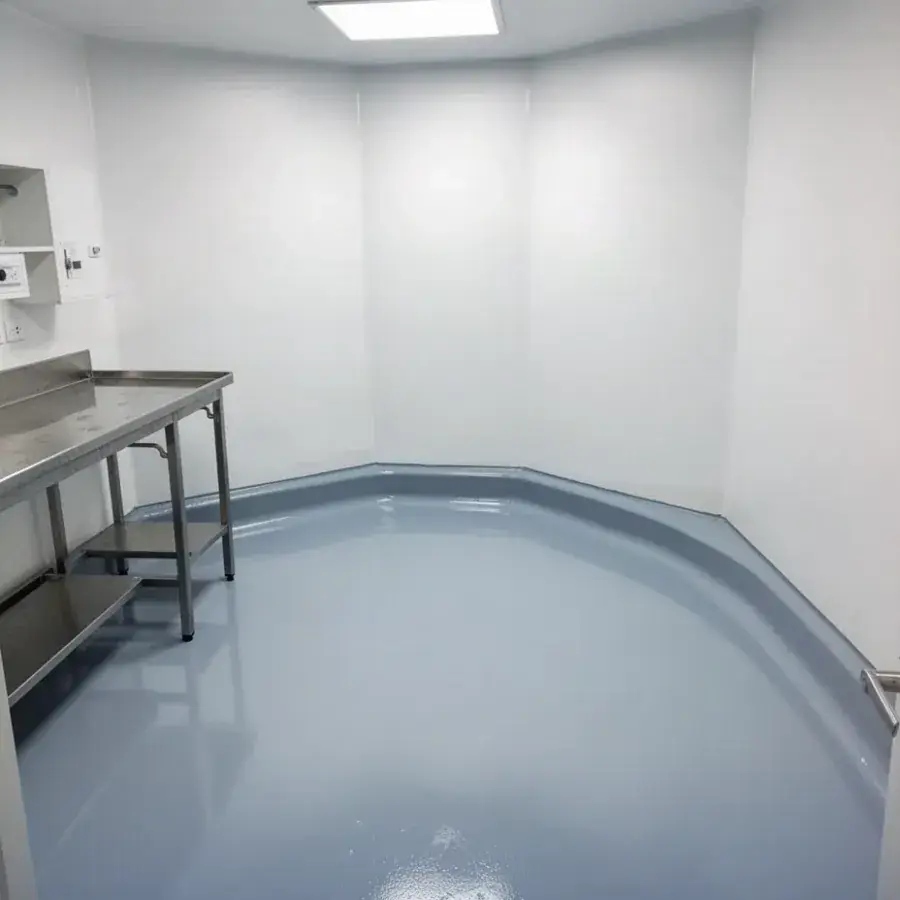
In areas washed daily the floor must be seamless, with no joints to trap dirt. We build an integral cove base in epoxy mortar, with a rounded radius between floor and wall, so mops and pressure washers leave no dirty corners.
Resolución 2674 de 2013 from Colombia's Ministry of Health and Social Protection sets sanitary requirements for food establishments, including impermeable, washable floors that slope toward the drains. Each plant's quality manager defines the exact scope; we build the floor to meet it.
For commercial kitchens with hot water, grease and steam cleaning, we recommend urethane cement instead of epoxy because it handles thermal shock better.
Vapor rising from a damp slab pushes on the resin and forms liquid-filled blisters weeks later. You diagnose it by cutting a blister open: if there is water and the concrete is dark, moisture is the source.
If the coating comes off in sheets with a gray film stuck to the back, the resin bonded to laitance or dust instead of concrete. It is the classic mistake of painting without grinding.
Air in the pores escapes as the slab warms up, leaving craters and bubbles. We prevent it by priming in the afternoon as the concrete temperature drops and sealing pores before the body coat.
A 4-mil paint in a warehouse with pallet jacks wears through along the traffic lanes in months. Thickness is chosen for the load, not for today's budget.
Rolling carts or moving shelving too soon marks and debonds the system. With Medellín's humid air, a greasy film (amine blush) can also form if the dew point is not controlled.
As a 2026 reference in Medellín, a roller-applied epoxy coating costs COP $45,000 to $90,000 per m², and self-leveling epoxy COP $90,000 to $180,000 per m². The final price depends on the site visit and the condition of the slab.
| System | Installed price per m² | Expected lifespan |
|---|---|---|
| Roller-applied epoxy | COP $45,000 to $90,000 | 2 to 5 years |
| Self-leveling and decorative self-leveler | COP $90,000 to $180,000 | 8 to 12 years |
| Epoxy mortar, metallic and urethane cement | Set at the site visit | 10 years or more |
A 200 m² warehouse with self-leveling epoxy normally takes 4 to 6 days, prep included.
We measure moisture, hardness and contamination, and inspect cracks and joints.
Diamond grinding, vacuuming, crack repair and joint treatment.
A low-viscosity epoxy primer that soaks into the pores; two coats on very porous slabs.
Self-leveler spread with a notched trowel and a spiked roller to release air, or mortar applied by trowel.
Epoxy sealer, or aliphatic polyurethane where there is sun, with anti-slip aggregate in wet areas.
The area stays closed while it cures, then line striping and handover with a signed completion record and cleaning advice.
Yes. Epoxy resins yellow and lose gloss under UV light, even through a shop window.
In open garages, terraces and shops with glass storefronts, we finish with aliphatic polyurethane, which is UV-stable and resists scratching better.
At 20 to 25 °C (68 to 77 °F), foot traffic is allowed at 24 hours and light vehicles at 72 hours. Full chemical cure, needed before chemical exposure or heavy washing, takes about 7 days.
In Eastern Antioquia, with cooler nights, those times run longer and we adjust the schedule.
It can, with conditions. Every tile must be solid (we tap-test them one by one), the glaze is opened with diamonds and grout lines are filled so they do not telegraph through.
The risk is that a hollow tile later breaks loose and cracks the coating. If there are many, it is safer to remove the tile or level over it with a thick self-leveler.
Porcelanato líquido, as it is sold locally, is a decorative high-gloss self-leveling epoxy designed for interiors. What separates it from an industrial system is the loads, chemicals and impact each formulation is built to withstand.
Send us photos of the slab, the area and the use (forklifts, chemicals, washdown or vehicles), and we will schedule a free diagnosis anywhere in the Aburrá Valley. Your written quote spells out the system, thickness and number of coats.
The installation comes with a 1-year labor warranty; read the details in our warranty.
Pisos Pro Medellín
Tv. 6 #45-115, El Poblado, Medellín, Antioquia, Colombia
Monday to Saturday: 7:00 a.m. to 9:00 p.m.
Sunday: 9:00 a.m. to 9:00 p.m.