Borate salts
Soaking or impregnation with boric acid and borax is the most common method for guadua in Colombia. It protects against insects and fungi without making the indoor air toxic.
Bamboo and guadua floors
Pisos Pro Medellín installs bamboo floors and guadua planks in Medellín apartments, Envigado houses and country homes (fincas) in Eastern Antioquia. We have spent more than 15 years working only on floors and have completed over 900 jobs.
Bamboo is a grass that is harvested at 4 to 6 years and regrows from the same root, which is why it appeals to people looking for a renewable floor with the warm look of wood. Chosen and treated well, strand woven bamboo outlasts many hardwoods.
Our work starts before installation: confirming with the supplier that the bamboo was cured against insects and measuring the moisture of the planks. Those two checks decide whether the floor lasts decades or gets bored through by insects within two years.
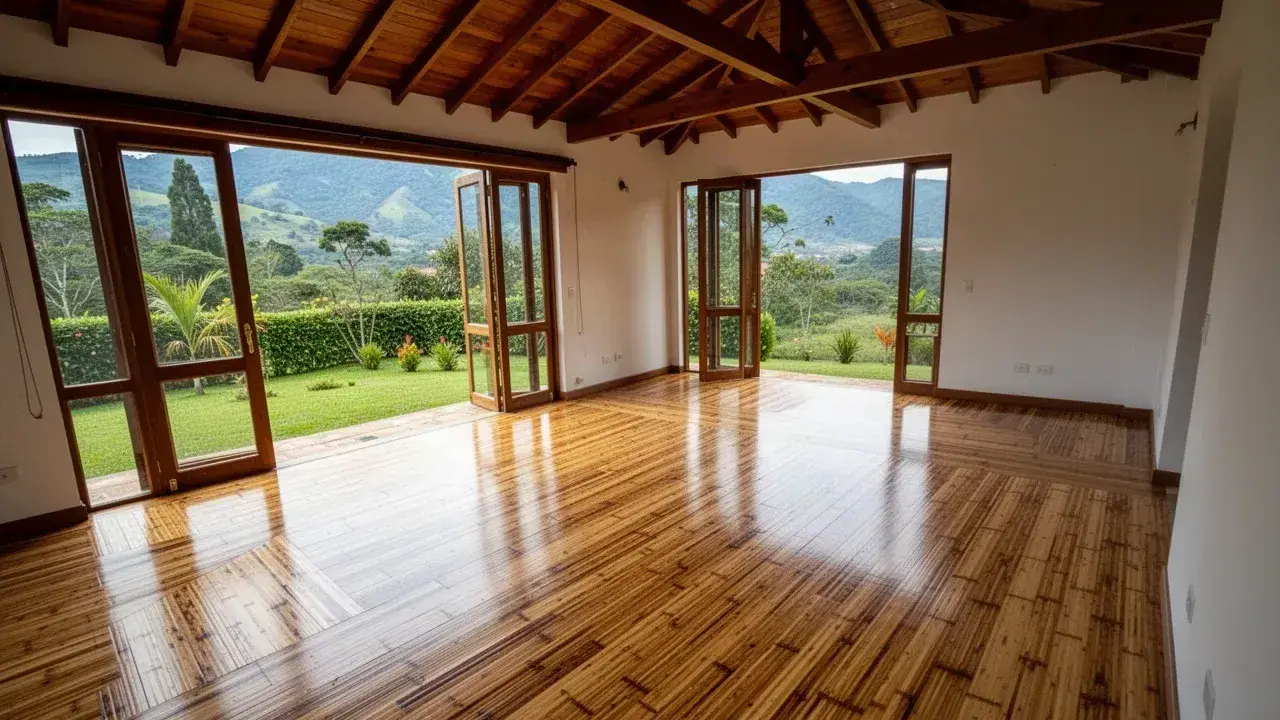
Bamboo flooring is made in two ways: planed cane strips glued into planks, or crushed fibers pressed with resin into very dense blocks. Both are sold as tongue-and-groove or click-lock planks with a factory finish.
We help you pick the type based on how the space is used, review the batch documentation and handle the full installation, including underlayment, baseboards, transition strips and cleanup.
We install it mostly in country homes in Llanogrande and Rionegro, Laureles houses with interior courtyards, yoga studios and apartments of clients who prioritize low-impact materials.
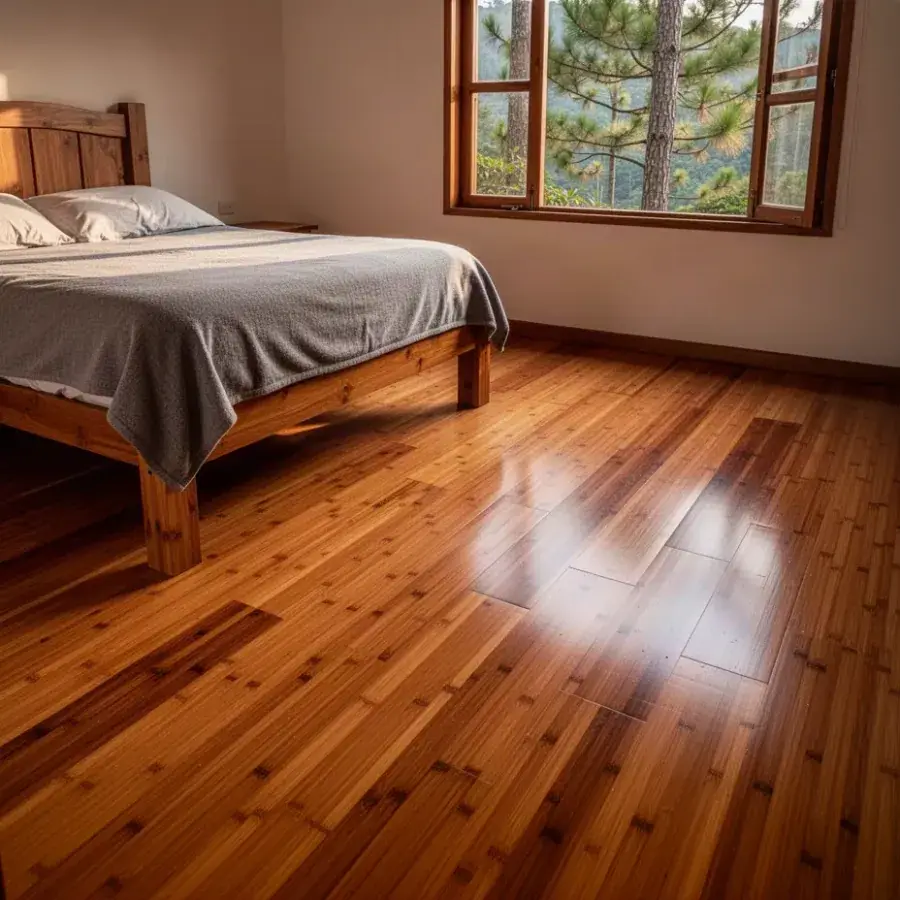
The way the bamboo is pressed sets its hardness and stability. For living rooms, hallways and shops we recommend strand woven; the other two perform well in bedrooms and studies.
| Type | Look | Relative hardness | Stability |
|---|---|---|---|
| Horizontal | Visible cane knuckles (nodes), wide strips | Medium, similar to red oak | Medium |
| Vertical | Fine, uniform lines with no visible nodes | Medium | Medium |
| Strand woven (pressed fiber) | Irregular grain resembling tropical hardwood | Very high, can be double that of oak | High |
| Carbonized (any type) | Caramel or brown tone | Lower than the natural version of the same type | Similar to natural |
Guadua angustifolia is Colombia's native bamboo and grows in the Coffee Region (Eje Cafetero), Valle del Cauca and parts of Antioquia. A few Colombian workshops split, plane and press it into planks for flooring and wall cladding.
Its advantages are a nearby source and a look that Asian bamboo does not have. Before buying, ask the supplier the harvest age of the canes, the preservation method, the moisture content at delivery and whether the plank has a factory finish.
Guadua needs more scrutiny than imported industrial product, because every workshop does things differently. We inspect a sample from the batch before agreeing to install it.
Bamboo fibers contain starch, and if the cane was not cured properly that starch feeds the bamboo powderpost beetle (Dinoderus minutus), which leaves round holes of 1 to 2 mm and fine powder.
Soaking or impregnation with boric acid and borax is the most common method for guadua in Colombia. It protects against insects and fungi without making the indoor air toxic.
Steam and heat treatment breaks down part of the sugars and darkens the cane. It makes the bamboo less attractive to insects, at the cost of some hardness.
We ask for the treatment data sheet and check a random box for holes or powder. If even one sign shows up, that batch does not get installed.
We inspect nearby door frames, closets and baseboards for termites (comején) before the floor is closed in. Our guide to termites and pests in floors shows what to look for.
Bamboo is not wood, but it absorbs and releases water from the air just the same. A bamboo floor laid tight in December can buckle in May, when the rains arrive and indoor humidity rises.
That is why we leave the boxes open on site for 3 to 7 days, check the planks with a moisture meter and keep a 12 to 15 mm expansion gap around the perimeter. In rooms longer than 10 m we add an intermediate expansion strip.
On ground-floor slabs or in country homes in Eastern Antioquia, where the ground is damper, we first install a moisture barrier and then the underlayment. Our guide to humidity and floors in Medellín goes deeper into these causes.
In Medellín in 2026, installed bamboo flooring costs COP $160,000 to $300,000 per m². Material ranges from $120,000 to $240,000 and labor from $35,000 to $55,000; the final figure comes after we visit the space.
| Factor | Lower range | Higher range |
|---|---|---|
| Pressing type | Horizontal or vertical | Strand woven |
| Finish | Natural with UV lacquer | Carbonized or with reinforced aluminum oxide coating |
| System | Floating click-lock | Tongue-and-groove glued with MS polymer |
| Origin | Standard imported line | Made-to-order guadua from a Colombian workshop |
| Subfloor | Flat, dry slab | Slab needing self-leveler and a barrier |
We measure the area and the subfloor moisture, and open a box to check treatment, color and plank squareness.
The planks rest in the space for 3 to 7 days, with daily readings until they stabilize.
We grind down high spots, apply a barrier if the slab calls for it and roll out acoustic underlayment for the click system.
With click planks, joints are closed using a tapping block; for glue-down, we spread elastic adhesive and weight the planks until it sets.
Baseboards cover the expansion gap, transitions go in, and we hand over with a signed completion record (acta) and a dry-cleaning guide.
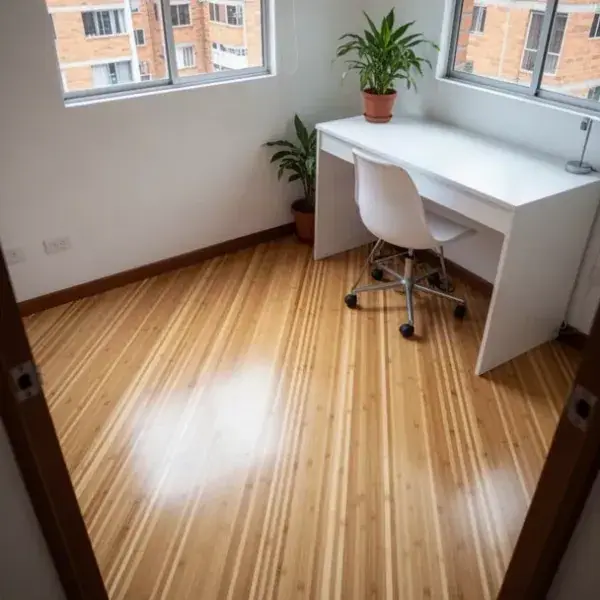
Light vertical bamboo visually opens up small apartment studies and bedrooms. Strand woven stands up to rolling office chairs and the constant foot traffic of a family living room.
On the other hand, we do not recommend it for uncovered terraces, bathrooms or laundry areas, where standing water stains and swells it.
It depends on the type. Horizontal and vertical bamboo are about as hard as oak, while strand woven, thanks to its density, beats many hardwoods in indentation tests.
The darker color comes from pressurized steam and heat, which break down part of the lignin and sugars in the fiber. It looks great, but the plank loses hardness compared with the natural version of the same type.
It can in open kitchens with normal use, using strand woven and wiping spills right away. Ask for a protective mat under the sink and fridge; if you worry about leaks, engineered hardwood or a synthetic floor holds up better.
Tell us the area and how the space is used by WhatsApp, phone or the form, and we will schedule a free visit.
Your bamboo floor is covered by a 1-year labor warranty; see what it includes on our warranty page.
Pisos Pro Medellín
Tv. 6 #45-115, El Poblado, Medellín, Antioquia, Colombia
Monday to Saturday: 7:00 a.m. to 9:00 p.m.
Sunday: 9:00 a.m. to 9:00 p.m.