Technical guide

Humidity and floors in Medellín: how moisture affects each material

Pisos Pro Medellín is a company dedicated to installing and repairing floors for homes and businesses in the Aburrá Valley and Eastern Antioquia. Before laying any moisture-sensitive floor we test the subfloor, because moisture is the cause of damage we run into most.

Across more than 15 years and 900+ jobs, we have pulled up swollen laminate, peeling vinyl and hardwood with fungus growing underneath. This guide explains why it happens in our climate and how to prevent it.

  • Local climate
  • Material-by-material table
  • Warning signs
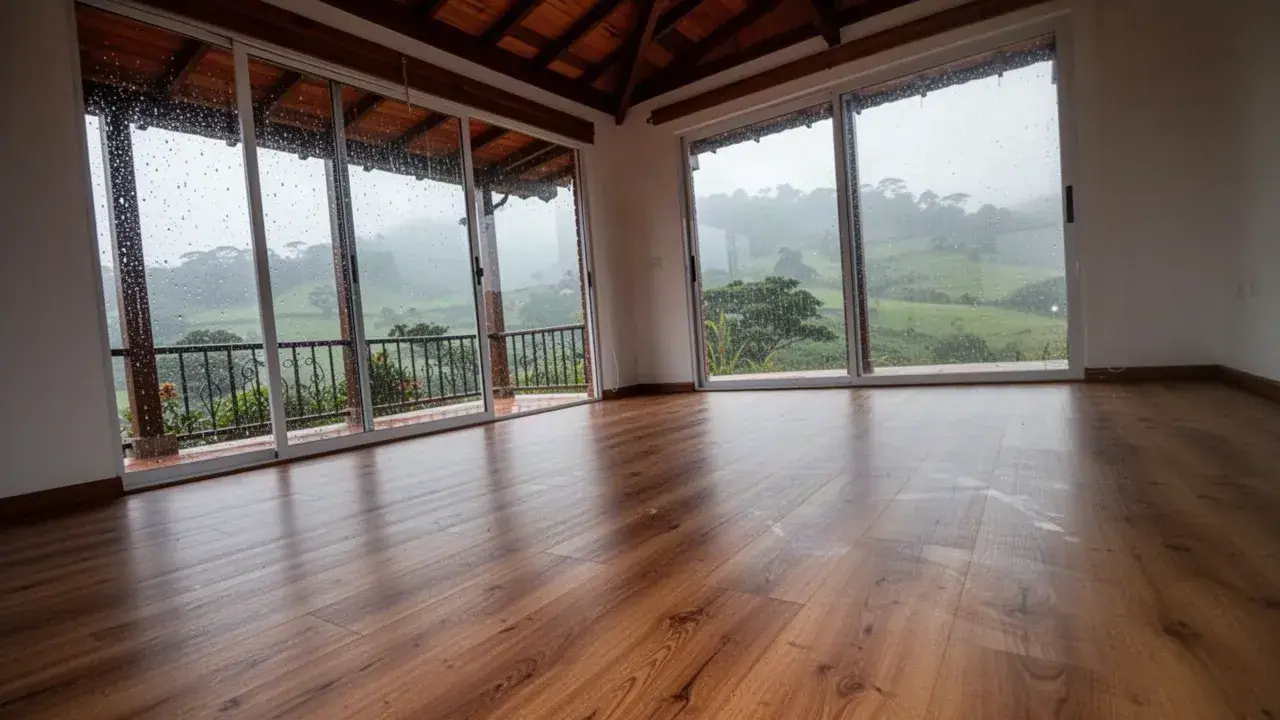
Oak-tone SPC floor in a Rionegro country house

The climate of the Aburrá Valley and Eastern Antioquia

Medellín and the rest of the Aburrá Valley sit at roughly 1,500 m above sea level, with mild weather all year. There are two rainy seasons, approximately April to May and October to November, bringing heavy afternoon showers.

Eastern Antioquia, home to Rionegro, Llanogrande, La Ceja and Marinilla, lies above 2,000 m. It is cooler and cloudier, with frequent morning fog and less sunshine to dry out patios and walls.

Air humidity rises and falls every day, so hardwood and laminate shift slightly all year round. What truly ruins a floor is water arriving from below or from a leak.
Three sources of moisture: air, subfloor and leaks

Each source leaves a different trail, and mixing them up leads to fixing the wrong problem.

Ambient humidity

This is water vapor in the air, high during the rainy season and in closed-up rooms. It affects the whole space evenly and changes from week to week.

  • Planks slightly cupped across the whole floor
  • Wooden doors that stick
  • Improves with ventilation

Subfloor moisture

It rises from the concrete slab or the ground: ground-floor units, houses built on soil and slabs that are freshly poured or still in unfinished (obra gris) condition. It damages from below and gets worse in unventilated areas.

  • Dark patches or white powder on the slab
  • Bubbles in glue-down vinyl
  • A musty smell when a plank is lifted

Leaks

Liquid water coming from a pipe, a window seal, a balcony or the apartment upstairs. The damage is localized and usually appears suddenly.

  • Swelling or a stain in one spot
  • Wet baseboard near a bathroom or kitchen
  • Gets worse right after a downpour

How each flooring material reacts to moisture

If moisture is what has you torn between laminate and SPC, our laminate vs SPC vs vinyl comparison goes deeper.

General behavior; each product's technical data sheet sets the exact moisture limits.
MaterialReaction to moisturePrecaution in Medellín and Eastern Antioquia
LaminateThe HDF swells at the seams and forms peaks; the damage is permanentPolyethylene barrier over cement, and never in bathrooms
SPC and WPCThe core does not swell, but water can get trapped underneath and breed moldTest the subfloor all the same; seal the perimeter in wet areas
Glue-down vinyl (LVT)Vapor from the slab loosens the adhesive: bubbles and lifting tilesStrict moisture testing and, if needed, a sealer before gluing
Solid hardwoodAbsorbs and releases water; cups when wet and opens gaps as it driesAcclimate, add a barrier and ventilate; treat ground floors first
Engineered hardwoodMore stable thanks to its cross-layered build, though water still cups itSame testing; a better choice than solid wood in cool Eastern Antioquia homes
Porcelain and ceramic tileWater does not harm it, but a damp slab causes efflorescence and hollow tilesFully cured subfloor and the right adhesive
CarpetHolds moisture in the backing and encourages mold and dust mitesAvoid on ground floors and in unventilated rooms
MicrocementVapor from below causes stains and loss of adhesionDry slab and a barrier before the system goes on

Acclimation and the expansion gap

Flooring stored in a cold warehouse in Eastern Antioquia does not hold the same moisture as a sunny Laureles apartment. Acclimating means leaving the boxes closed in the final room, normally for 48 hours or whatever the manufacturer specifies, so the material balances with the air.

The expansion gap is the 8 to 10 mm space left along walls, columns and door frames. When humidity climbs, the floor grows into that gap instead of pushing against the wall and lifting.

That space stays hidden under the baseboard and is never filled with silicone or filler. For nailed or glued solid hardwood, the clearance is calculated from the wood species and plank width.

Moisture warning signs in your floor

Peaked seams

Plank edges rise and form a raised ridge. On laminate it points to water in the joints and almost always means replacing the affected planks.

Cupped planks

The sides of each plank sit higher than the center. It is a classic sign of moisture rising from below in hardwood and laminate.

Musty smell

A stale odor that will not clear with fresh air suggests water trapped under the floor or behind the baseboard. It is worth checking before stains appear.

Stains and mold

Black or greenish spots on baseboards, joints or the back of rugs. On a ground floor, the source is usually the subfloor.

White powder on the slab

This is efflorescence: salts carried out of the concrete by water. You see it when an old floor is lifted or in the grout lines of tile.

Mold and fungus under carpet and hardwood

Mold needs moisture, organic material and poor airflow. Under carpet or a hardwood floor at ground level, all three come together easily.

The most common cases are ground-floor bedrooms with wall-to-wall carpet, closets against exterior walls and Eastern Antioquia country houses left shut for weeks. Once mold appears, the affected material has to come out, the slab must be dried and treated, and the cause removed before any new floor goes in.

  • Test subfloor moisture before installing carpet or hardwood
  • Use a vapor barrier and an underlay that does not hold water
  • Air the home daily, especially in the rainy season
  • Avoid rubber-backed rugs on hardwood
  • Run a dehumidifier in houses that stay closed up

Test for moisture before you install

During the site visit we check the subfloor with a moisture meter at several points. If readings come back high, we install a moisture barrier or correct the slab through floor and subfloor repair.

For spaces that will stay exposed, such as ground floors and Eastern Antioquia homes, an SPC floor or porcelain tile holds up better than laminate.

If this explanation helped, our Medellín flooring guides cover more practical topics.

Pisos Pro Medellín

Tv. 6 #45-115, El Poblado, Medellín, Antioquia, Colombia

info@pisosmedellin.com

Monday to Saturday: 7:00 a.m. to 9:00 p.m.

Sunday: 9:00 a.m. to 9:00 p.m.

Free quote