Terrazzo (terrazo)
This is the technical, international name. Architects and designers use it for any polished floor with visible aggregate, whether cement-based or epoxy.
Poured terrazzo, terrazzo tile and restoration
At Pisos Pro Medellín we build terrazzo floors, a material almost everyone in Antioquia calls granito, either poured in place or as tile for homes, shops and lobbies. We are flooring specialists with more than 15 years of work in the Aburrá Valley.
We work with architects and owners who want a seamless floor with a custom design, businesses that need a surface able to take decades of traffic, and families hoping to bring back the original granito in an older house.
Across more than 900 jobs we have seen 50-year-old granito shine again and brand-new terrazzo ruined by rushed grinding. We tell you plainly which system suits you and back it with a 1-year labor warranty.
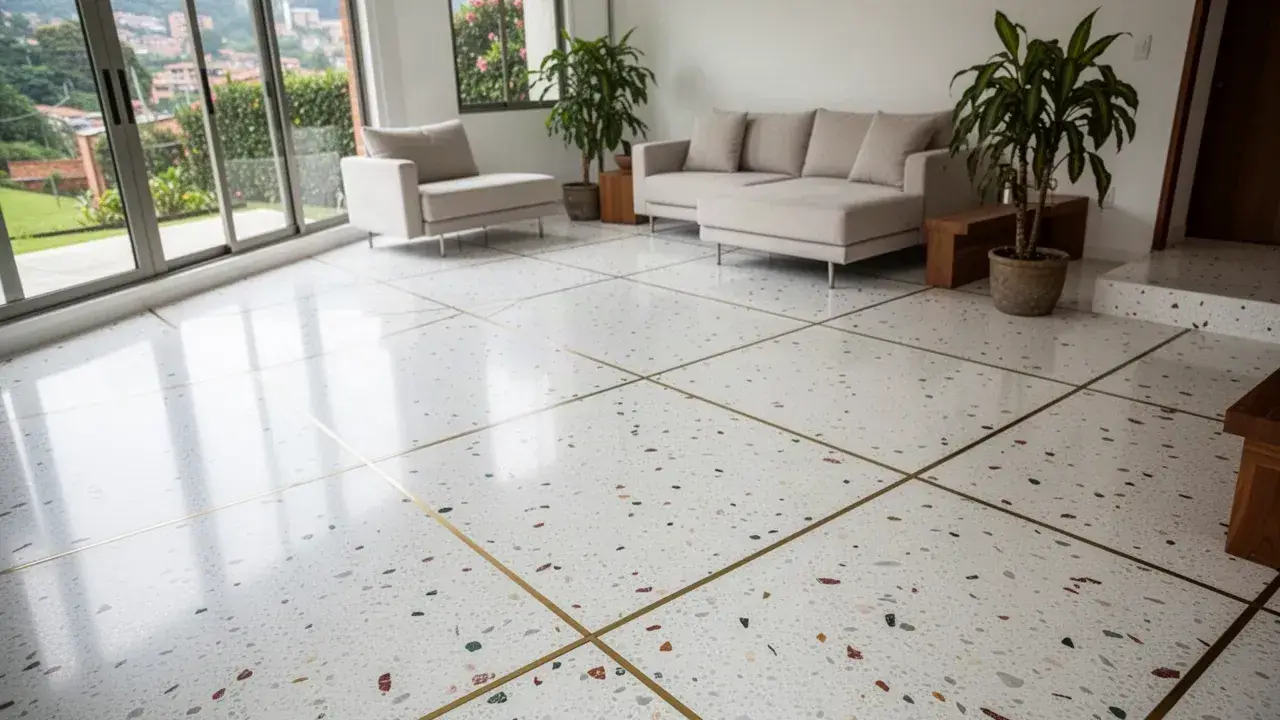
Terrazzo is a blend of marble, granite or glass chips set in a cement or epoxy resin matrix. It is poured, left to cure, ground with diamond discs until the aggregate shows, and polished to the sheen you choose.
We install it poured in place, as a continuous surface divided by metal strips, or as precast tiles set like any other tile. The service covers base preparation, divider strips, pouring or setting, grinding, grouting the pores, polishing and sealing.
If you want a more understated seamless floor without decorative aggregate, compare it with polished concrete.
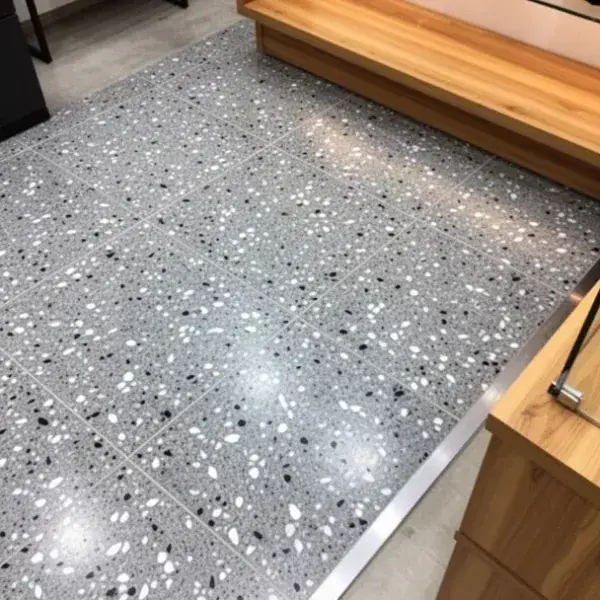
This is the technical, international name. Architects and designers use it for any polished floor with visible aggregate, whether cement-based or epoxy.
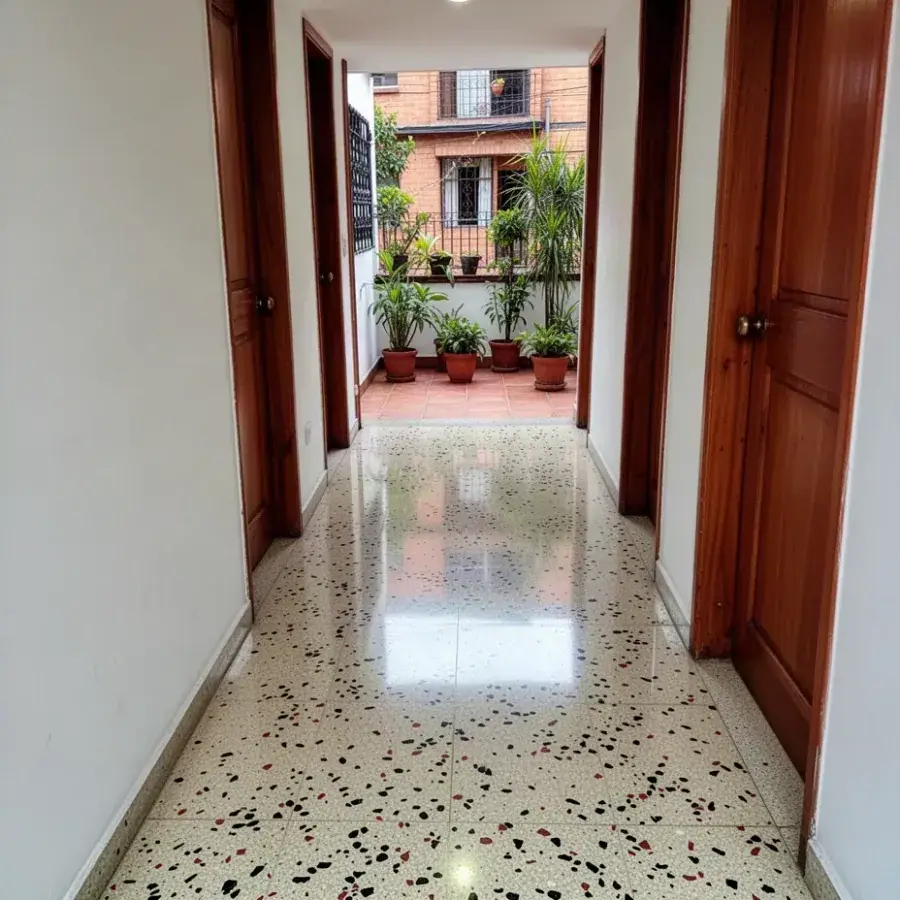
This is what Colombians call the polished terrazzo found in houses and buildings from the 1950s to the 1980s. It is not natural block granite; that rock is part of our natural stone and marble flooring service.
This is the rough outdoor version: the mix is washed with water before it hardens to leave the stone exposed. It goes on patios, ramps, sidewalks and exterior stairs because it is not slippery.
| Aspect | Poured in place | Terrazzo tile |
|---|---|---|
| Cost | COP $180,000 to $350,000 per m² installed | Lower; depends on the tile product |
| Time for about 60 m² | 2 to 3 weeks including curing and polishing | 1 to 2 weeks |
| Design freedom | Open: curves, logos and color changes | Limited to catalog sizes and colors |
| Joints | Metal strips dividing the floor into panels | Grout joint between tiles |
| Finish | Seamless, polished on site | Factory polished; reground on site to remove lippage |
Both are diamond polished and both accept metal divider strips. The choice depends on how much weight the slab can carry, how much sun the floor gets and the design you have in mind.
Brass or aluminum strips are anchored to the base before the pour and split the floor into panels. They control shrinkage as the cement dries, so any crack forms at the strip, where nobody sees it, instead of mid-panel.
In cement terrazzo we keep panels to 1.5 or 2 meters per side, and over the building's structural joints we install a double strip or a flexible joint. In a city with frequent tremors, as our guide to earthquakes and floors explains, that detail decides whether the floor cracks.
The same strips make patterns possible: medallions, a brand logo at a shop entrance, contrasting bands or a border framing a lobby. Brass turns golden when polished, while aluminum stays silver and costs less.
Many houses in Laureles, Belén and La América still have polished granito from 40 to 60 years ago under layers of wax, stains or ceramic tile glued on top. In most cases it can be brought back and ends up better than any new floor at the same price.
The job involves coarse diamond grinding to remove lippage and wear, filling pores and cracks with a color-matched paste, progressive polishing and a final crystallization or seal. Where a piece is missing, because a wall came down or a pipe was run, we fill it with a mix matched in aggregate and color.
We are upfront about the result: a new patch never matches 50-year-old granito exactly, because the original has already shifted in tone. We get it close with color samples tested before the pour.
The system, the design's complexity and the length of divider strip drive the price. A single-color floor with square panels sits at the low end; an epoxy floor with brass inlays sits at the high end.
Brass strips, patterns and color changes are added by linear meter and complexity, and everything is delivered in writing after the visit.
| Work | Reference range |
|---|---|
| Poured-in-place terrazzo, complete system | COP $180,000 to $350,000 per m² |
| Polishing and crystallizing existing granito | COP $25,000 to $45,000 per m² |
| Removing ceramic tile glued over old granito | COP $12,000 to $25,000 per m² |
| Installed terrazzo tile | Depends on the product, quoted at the visit |
| Filling missing areas with a matched mix | Depends on area and color, quoted at the visit |
We inspect the slab, level it with mortar and anchor the strips with beads of mortar at the finished floor height.
We mix white or gray cement, pigment and aggregate in fixed proportions, pour panel by panel and compact with a roller and trowel to bring the stone to the surface.
Cement terrazzo is kept damp and covered for 5 to 7 days before grinding. Epoxy terrazzo is ground after 24 to 48 hours.
With a planetary grinder and coarse diamond discs we open the surface until the aggregate shows evenly. We work wet and vacuum the slurry to protect the rest of the home.
We fill pinholes and air pockets with paste in the same color and let it harden before moving on.
We step up through finer grits in several passes until we reach the agreed finish: matte, satin or mirror.
We apply a penetrating sealer or crystallizer and hand over the floor with maintenance instructions.
Cement terrazzo needs 5 to 7 days of moist curing before the first grind and reaches full strength at around 28 days. Grind it sooner and the stone tears out of the matrix, leaving craters.
Epoxy terrazzo is ground 24 to 48 hours after the pour, depending on temperature and the resin's data sheet.
Terrazzo properly divided by metal strips absorbs a building's normal movement, and if a crack appears it usually hides along a strip. Cracks that run across panels almost always come from oversized panels or an ignored structural joint.
A hairline crack can be filled and polished without replacing the floor.
Yes, in most cases. If the granito is thick enough and still bonded to its base, grinding, filling and polishing give it an even shine in 2 to 4 days for a 40 to 60 m² area.
Deep rust stains and structural cracks fade but do not disappear completely, and we tell you so before we start.
Tell us whether you want new terrazzo or to restore existing granito, and we will schedule a free visit. We run color samples when the project calls for it and send the quote in writing.
Both installation and restoration carry a 1-year labor warranty, with clear terms on what is and is not covered.
Pisos Pro Medellín
Tv. 6 #45-115, El Poblado, Medellín, Antioquia, Colombia
Monday to Saturday: 7:00 a.m. to 9:00 p.m.
Sunday: 9:00 a.m. to 9:00 p.m.