Water-based polyurethane
It is the option we recommend most for occupied apartments: low odor, a natural color that does not yellow, and dry to the touch in 2 to 3 hours. Brands such as Bona offer two-component lines for heavy traffic.
Wood floor sanding and finishing
At Pisos Pro Medellín we sand, buff and refinish solid hardwood, parquet and engineered wood with enough wear layer, and we replace boards damaged by water or termites (comején). The goal is to bring back your floor's color and protection without replacing it.
We work in El Poblado and Laureles apartments, older houses in Belén and Envigado, and offices with wood floors that are decades old. Over 15-plus years and more than 900 flooring jobs, we have learned to tell when a fresh finish coat is enough and when a full sanding is needed.
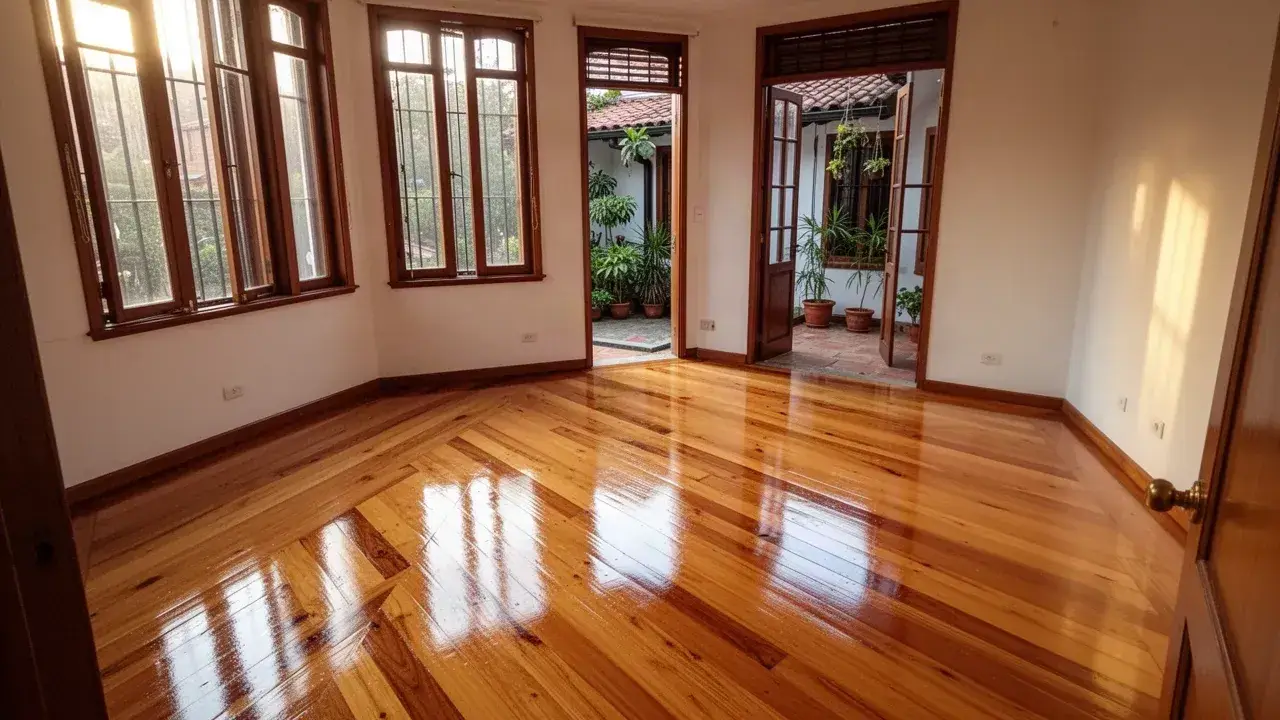
We start by assessing the usable wood thickness, the existing finish and any localized damage. That tells us whether the floor needs a full sanding, just a recoat, or repairs first.
We work on solid hardwood, strip parquet and engineered wood with a wear layer of 3 mm or more.
We check the wear layer by removing a baseboard or a floor vent and looking at the edge of a board. If the floor has been sanded several times, we confirm the tongue is not showing before promising another sanding.
| Floor condition | Usual cause | Recommended fix |
|---|---|---|
| Surface scratches and dull sheen | Grit, pets, furniture legs without felt pads | Screen and recoat without reaching bare wood |
| Finish worn through in traffic lanes | Normal wear after years of use | Full sanding and refinishing |
| Gray or black stains | Water reacting with the tannins in the wood | Sanding; if the stain is deep, board replacement |
| Boards with tunnels or fine powder | Termites or wood-boring beetles | Pest treatment and board replacement |
| Cupped or crowned boards | Moisture coming up from the subfloor | Fix the moisture, let it stabilize, then sand |
| Engineered wood with a wear layer under 2 mm | Product design | Recoat only, or replace |
Our sanders have dust extraction connected to a bag or a vacuum unit that captures most of the dust right at the machine. Dust-free sanding does not exist; the honest claim is that there is far less of it and it stays under control.
Before we start, we seal bedroom, closet and kitchen doors with plastic and cover outlets and vents. Between finish coats we remove fine dust with a vacuum and tack cloth, and we ask for cross-ventilation during application.
In apartment buildings we agree on noise hours with building management (administración), because a drum sander can be heard several floors away.
Sheen is a separate choice: matte and satin hide scratches and dust, while semi-gloss and gloss bring out the grain but show every mark. Nearly all finishes reach full hardness in about a week, even though you can walk on them sooner.
It is the option we recommend most for occupied apartments: low odor, a natural color that does not yellow, and dry to the touch in 2 to 3 hours. Brands such as Bona offer two-component lines for heavy traffic.
It gives a warm amber tone and a hard film, but it smells strongly for days and the space has to be vacated. We use it in shops or empty houses when the client wants that look.
It soaks into the wood and leaves a very natural matte look. Worn spots can be touched up without sanding the whole floor, in exchange for more frequent maintenance.
When a board is rotten, deeply stained or tunneled by termites, we cut it out without harming its neighbors and inspect the sleepers or subfloor underneath. If termites are active, a pest control company must treat them first, because laying new wood over a live colony throws the investment away.
The replacement comes from the same species (sapán, chanul, roble, abarco or others), is milled to the same thickness and goes in before the general sanding. Sanding and finishing everything together greatly reduces the color difference, although the new board may look lighter for a few months while it oxidizes.
To spot the problem early, read our guide on termites and carpenter ants in floors.
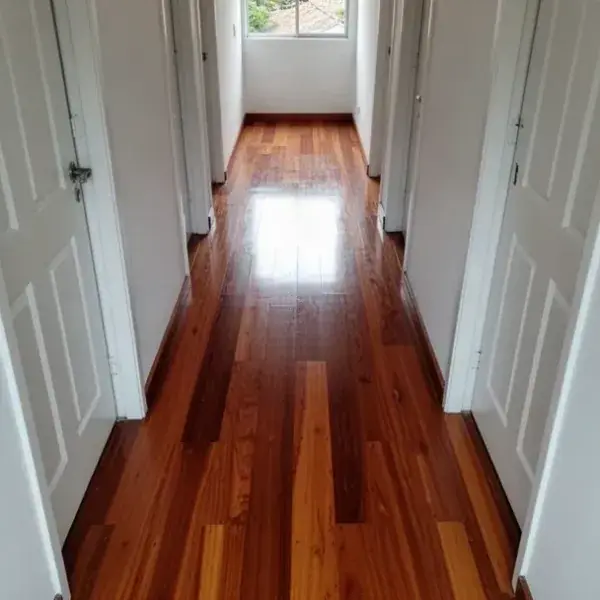
Glued-down strip parquet is common in apartments built from the 1970s to the 1990s in Laureles, Estadio and downtown. Over time the adhesive crystallizes and the strips sound loose or pop off.
We lift them, clean off the old adhesive and reglue them with polyurethane wood flooring adhesive; missing strips are replaced with the same species. Then we sand diagonally to the pattern so we do not leave grooves, and finish with an orbital sander.
If you would rather have a new pattern than restore, see our herringbone and parquet flooring service.
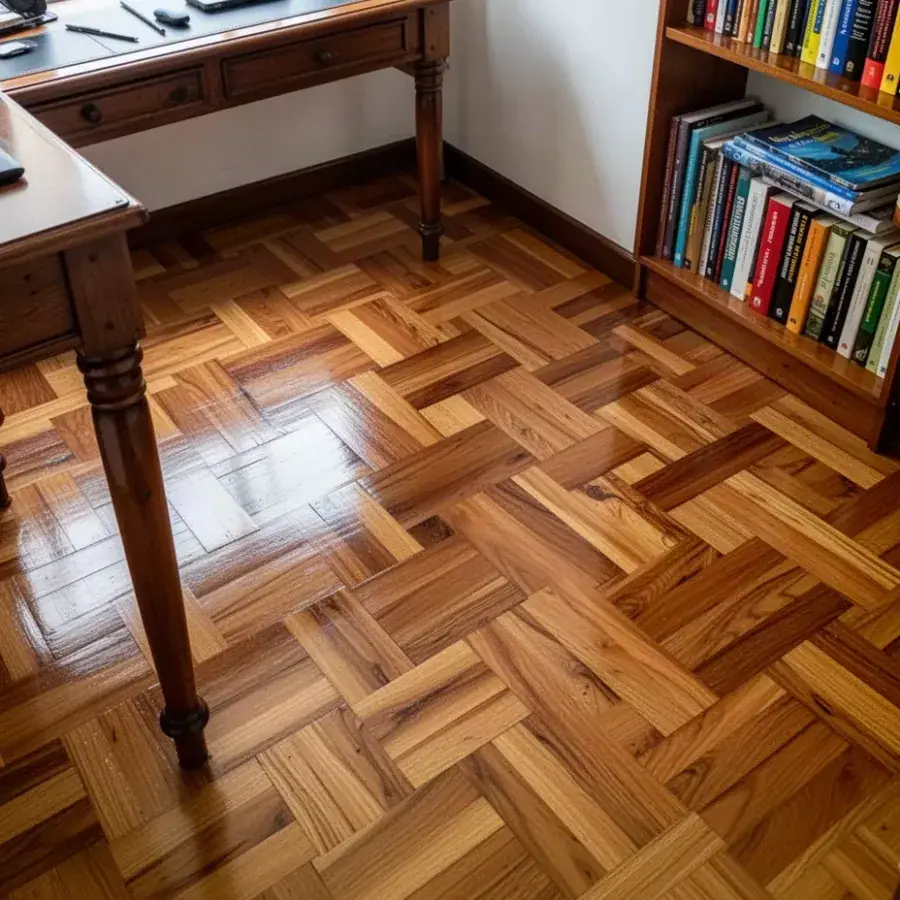
As a 2026 reference for Medellín, sanding and refinishing wood costs COP $45,000 to $85,000 per m², with sealer and finish included. The price rises with the number of coats, a two-component finish, stain and any repairs needed first.
Boards to be replaced are quoted per piece or per m² depending on the species. If a solid floor is badly deteriorated, we compare this cost with a new solid hardwood floor so you can decide with real numbers.
A 60 to 80 m² apartment takes 3 to 5 days. With many boards to replace or with stain, it can run to 6 or 7.
We protect the space, remove baseboards if needed and run 36 or 40 grit to strip the old finish and flatten the boards.
We continue with 60 and 80 grit, fill gaps and swap out boards. The edger reaches the perimeter and a hand scraper handles the corners.
A final pass with 100 or 120 grit and an orbital sander erases the machine marks. We apply stain, if any, and the sealer.
We apply two or three coats with a light sanding between each one. Every coat needs to dry before the next goes on.
You can walk on it in socks after 24 hours and bring furniture back with felt pads after 48 to 72 hours. Rugs wait a week.
It depends on the usable thickness, meaning the wood left above the tongue. Each full sanding removes half a millimeter to a full millimeter, so a 19 to 20 mm (3/4 in) solid board can take several sandings over its lifetime.
If the tongue already shows at the edge, the next option is recoating, not sanding.
During sanding there is noise, some fine dust and areas you cannot walk on. Water-based finish has little odor, but we recommend that children, pets and anyone with asthma stay elsewhere on the finishing days.
If some bedrooms are outside the work area, we work in phases so you always have a livable space.
Yes, if the wear layer is 3 mm or more: it can take one or two light sandings. At 2 mm only a very light sanding works on flat floors, and below that it can only be recoated.
If your engineered hardwood has a thin wear layer and is badly worn, replacing it may make more sense.
The work carries our 1-year labor warranty against application defects, such as finish that peels or flakes off. It does not cover scratches from dragged furniture, water damage or pests that appear later.
Send us photos of the floor and, if you can, of a board edge next to a baseboard or floor vent. With that we give you initial guidance and book a free site visit to measure and quote in writing.
The work is covered by a 1-year labor warranty.
If you also have other damaged floors, take a look at our floor repair services in Medellín.
Pisos Pro Medellín
Tv. 6 #45-115, El Poblado, Medellín, Antioquia, Colombia
Monday to Saturday: 7:00 a.m. to 9:00 p.m.
Sunday: 9:00 a.m. to 9:00 p.m.