Concrete moisture meter
This is the first reading, taken at several points in each room with extra attention to exterior walls, wet areas and corners that never get sun. It maps the slab and tells us where more precise tests are needed.
Moisture testing and vapor barriers
At Pisos Pro Medellín we test the moisture in your concrete subfloor (contrapiso) and install vapor barriers before laying hardwood, laminate, SPC, vinyl or epoxy coatings. This is the step that prevents swollen planks, adhesive that lets go and a musty smell months after the job is done.
We serve ground-floor apartments, hillside houses, shops and offices across the Aburrá Valley and Eastern Antioquia (Oriente antioqueño). With more than 15 years as flooring specialists and over 900 jobs completed, we have learned that in Medellín a slab that looks dry can still hold enough moisture to ruin a new floor.
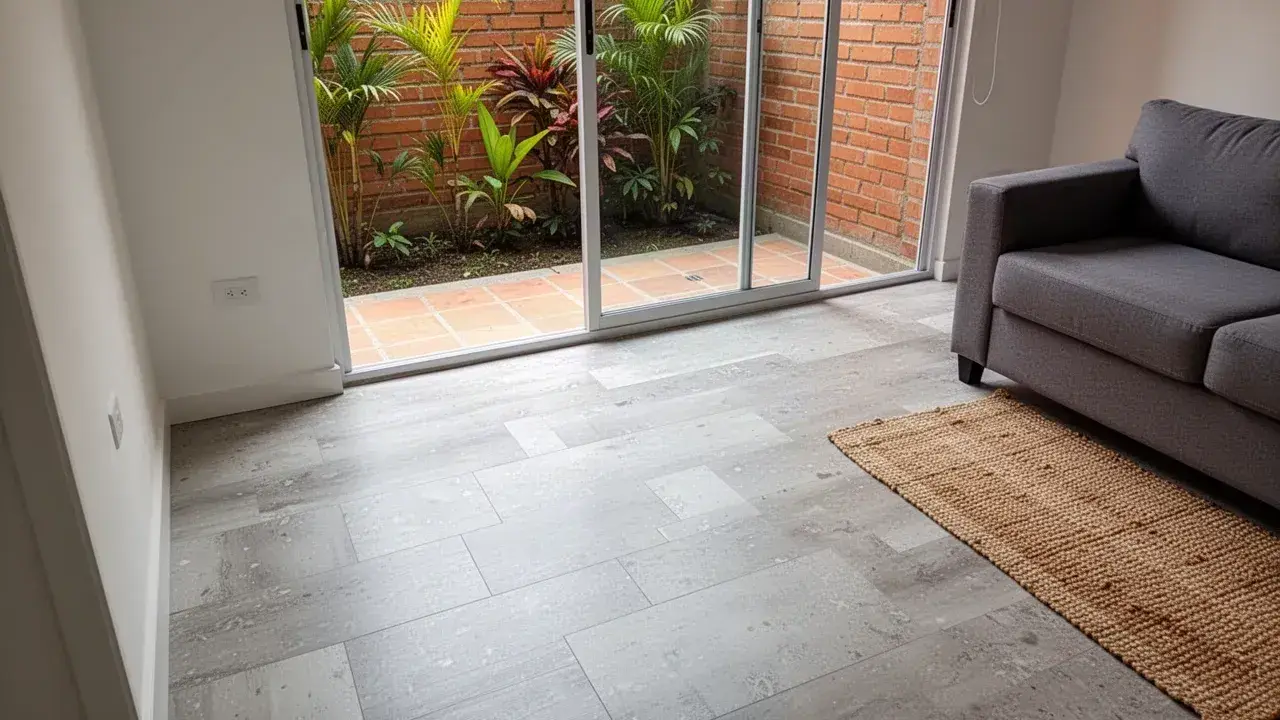
A moisture barrier is a layer placed between the concrete subfloor and the finished floor to stop water vapor rising from the slab or the ground beneath it. It can be a plastic sheet, an underlayment with a built-in film, or a liquid coating bonded to the concrete.
It is almost always needed on ground floors, in basements, in houses built on grade, over freshly poured slabs, and on any subfloor whose reading exceeds the limit set by the manufacturer of your chosen floor.
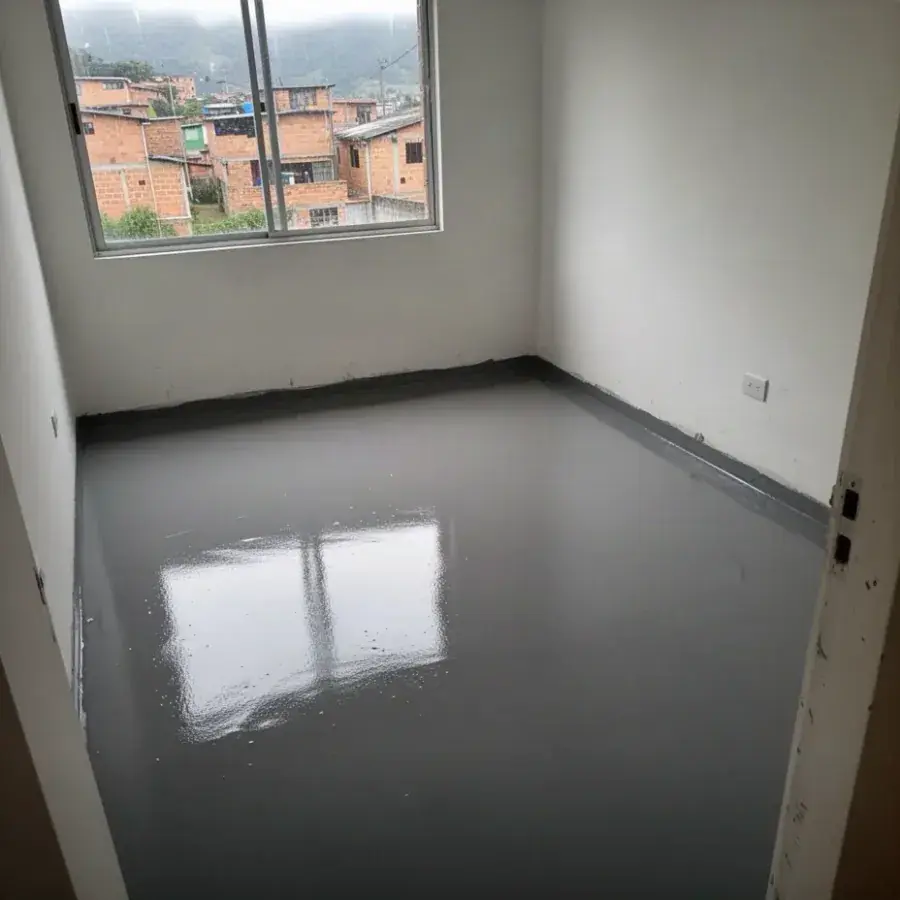
Concrete is porous: even when it looks dry, it keeps releasing vapor for months, and on ground floors it also wicks water up from the soil. That vapor gets trapped under the new floor and escapes through the joints.
In laminate, the HDF core absorbs the moisture and swells at the edges. Hardwood planks cup, and glue-down floors lose their bond and develop bubbles.
Polyethylene stops that vapor in its tracks. It is not an optional extra: many floating floor manufacturers make their warranty conditional on a barrier over concrete.
Each manufacturer sets its own limit. Many laminate and SPC products accept around 2% CM (carbide method) on cement subfloors, while hardwood and glue-down vinyl usually require lower readings, so we compare every result with the spec sheet of the floor you chose.
This is the first reading, taken at several points in each room with extra attention to exterior walls, wet areas and corners that never get sun. It maps the slab and tells us where more precise tests are needed.
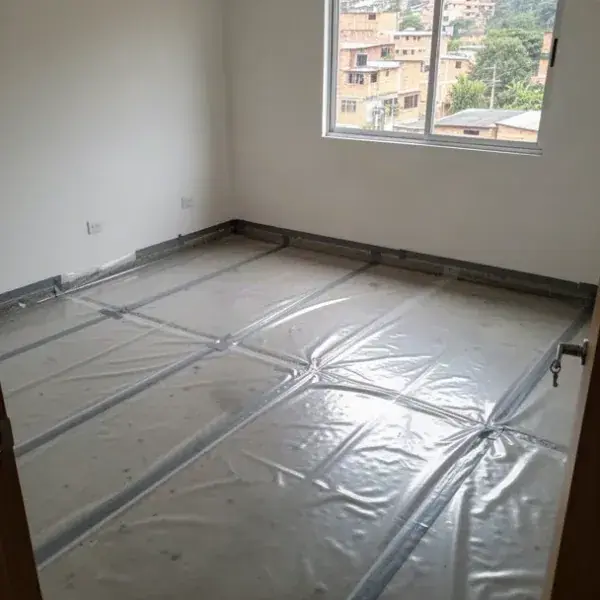
We tape down a square of polyethylene about 45 cm (18 in) across and leave it for 16 to 24 hours. Condensation underneath or darkened concrete means there is active moisture.
A dish of calcium chloride is sealed under a dome for 60 to 72 hours and then weighed. The weight gain shows how much moisture the slab is emitting, following ASTM F1869.
For high-value hardwood and glue-down floors we drill into the slab and insert probes that measure internal relative humidity, per ASTM F2170. It is the most reliable test on new slabs.
Plastic sheeting does not work under glue-down floors because the adhesive needs to grip the concrete; there, the barrier has to be liquid. We use systems from brands such as Sika, Mapei and Bostik, applied at the thickness and number of coats each spec sheet calls for.
| Barrier | When we use it | Compatible floors |
|---|---|---|
| High-density polyethylene (200 microns, about 8 mil) | Subfloors with moderate moisture under floating floors | Laminate, SPC, WPC and floating engineered hardwood |
| Underlayment with built-in vapor barrier | Dry or low-moisture slabs; saves a layer | Laminate and floating engineered hardwood |
| Moisture-blocking primer | Medium moisture where the floor is glued down | Glue-down vinyl (LVT), glued hardwood and microcement |
| Two-part epoxy membrane | High moisture, or new slabs that cannot wait | Epoxy, glue-down vinyl, glued hardwood and microcement |
A barrier controls vapor, not liquid water. If we find a leak, we tell you in writing and recommend a plumber or waterproofing specialist before installing, because no floor survives an active leak.
We cover these cases in more depth in our guide to humidity and floors in Medellín.
Groundwater climbs through the pores of the concrete. It is typical of ground floors, older houses without waterproofing and street-level shops, and it shows up as white efflorescence at the base of the walls.
Water vapor in the air turns into droplets when it touches a cold surface. It happens in foggy Eastern Antioquia homes, on slabs above open-air parking garages and in closed-up rooms; it usually appears before dawn and disappears once the sun is out.
This is water entering through a broken pipe, a poorly waterproofed terrace or a wall built against a hillside. It leaves stains that grow when it rains or when a nearby bathroom is used.
If laminate is your choice, also see our laminate flooring installation page, where we explain the acclimation and expansion gaps that work alongside the barrier.
| Floor | Needs a barrier? | Why |
|---|---|---|
| Laminate | Yes, always over concrete | HDF swells with vapor |
| SPC and WPC | Yes on ground floors and damp slabs | The core resists water, but trapped moisture grows mold in the underlayment |
| Engineered and solid hardwood | Yes, with mandatory testing | The most moisture-sensitive floor of all |
| Glue-down vinyl (LVT) | Primer or membrane if readings are high | Moisture breaks down the adhesive |
| Epoxy and microcement | Membrane if the slab is new or damp | Moisture causes blistering and delamination |
| Porcelain and ceramic tile | Usually not | Thinset mortar tolerates moisture; we check for efflorescence |
| Carpet | Yes on ground floors | Moisture causes odors and mildew |
As a 2026 reference for Medellín, a sheet, specialty underlayment or sealer barrier runs COP $25,000 to $70,000 per m² installed. An epoxy membrane costs COP $60,000 to $120,000 per m² because it requires mechanical prep of the concrete and a two-part product.
The final price is set after the site visit, and quotes are in Colombian pesos. If the barrier goes in with a new floor, it appears as its own line on the same written quote.
In a 60 to 80 m² apartment, a sheet barrier goes down the same day as the floor. An epoxy membrane adds 2 to 3 days for curing.
We take readings on a grid and mark them on a simple floor plan of the space. Those values go into the handover report.
We remove mortar residue, paint and dust; for liquid membranes we open the concrete pores with a disc grinder. Cracks are sealed before moving on.
Polyethylene is rolled out with 20 cm (8 in) overlaps sealed with tape, free of wrinkles or punctures. With liquid systems we control coverage per m² to reach the thickness the manufacturer specifies.
The barrier runs 5 to 10 cm up the wall and stays hidden behind the baseboard (zócalo). That keeps vapor from escaping at the perimeter, which is where a floor fails first.
We lay the finished floor right away over sheet barriers, or once a membrane has cured. It is a mandatory step under engineered hardwood, where moisture is the leading cause of claims.
Yes, when the subfloor is damp. The SPC core will not swell, but trapped vapor condenses, grows mold in the acoustic underlayment and can cause odors or stain the baseboards.
On dry slabs in upper-floor apartments, an underlayment with an integrated film is often enough; the moisture test decides.
No. A barrier stops vapor, not liquid water coming through a broken pipe, a terrace or a wall against the ground.
The leak is repaired first and the slab is left to dry; then we test again and install. If the concrete was damaged, our floor and subfloor repair service takes care of it.
It depends on thickness, ventilation and climate. The old rule of thumb is one month per 2.5 cm (1 in) of thickness, but with Medellín's ambient humidity it often takes longer.
That is why we install based on readings, not the calendar. If the project cannot wait, we apply an epoxy membrane.
Our 1-year labor warranty covers installation defects. It does not cover undisclosed subfloor moisture, leaks from the building or flooding, which is why testing and keeping records protects both sides.
If you are replacing the floor in a ground-floor unit, a hillside house or a country home (finca) in Eastern Antioquia, start by testing. The site visit and moisture test are free in the Aburrá Valley and nearby Eastern Antioquia, and your written quote arrives within 24 to 48 hours.
The installation is backed by our 1-year labor warranty.
A barrier is one of several fixes; see the rest on our floor repair in Medellín page.
Pisos Pro Medellín
Tv. 6 #45-115, El Poblado, Medellín, Antioquia, Colombia
Monday to Saturday: 7:00 a.m. to 9:00 p.m.
Sunday: 9:00 a.m. to 9:00 p.m.