Color palette
Grays, off-whites, sand, earth tones and soft greens or blues, tinted on site. We show samples on boards, because the dry color is lighter than the wet one.
Seamless floors, bathrooms and walls
At Pisos Pro Medellín we apply microcement to floors, bathrooms, showers, walls and built-in vanities in Medellín, Envigado, Sabaneta and Eastern Antioquia. We are flooring specialists with more than 15 years of experience and over 900 completed jobs.
Most of our clients are apartment and house owners who want to renovate without demolition: microcement goes over the existing tile and leaves a continuous surface 2 to 3 mm thick. We also serve shops, medical offices and restaurants looking for a modern, joint-free finish.
It is a hand-crafted finish, and two applicators using the same product get different results. That is why we explain each coat, each drying time and why microcement cracks when the base is not prepared.
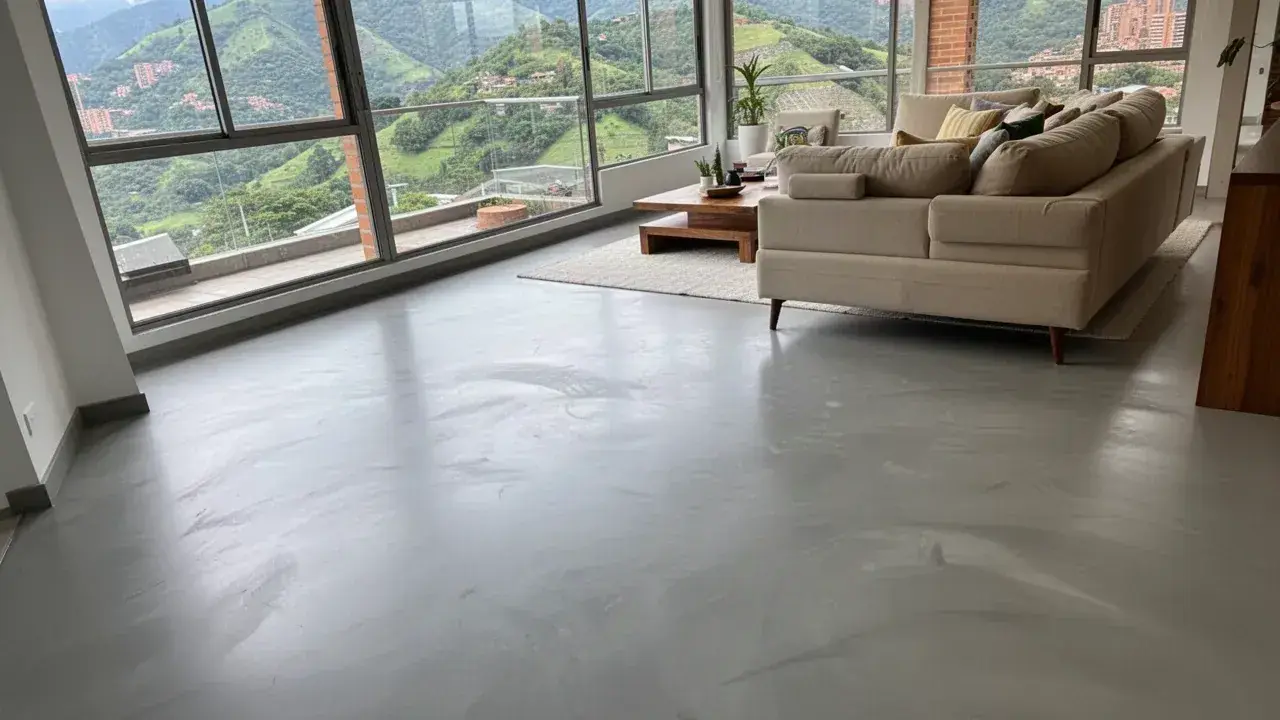
Microcement is a coating of cement, fine aggregates, resins and pigments applied by trowel in thin coats. Finished, it measures 2 to 3 mm and works on floors, walls, stairs, countertops and bathroom vanities.
We use complete systems from brands such as Topcret, with primers, base mortars, finish coats and sealers designed to work together. Mixing one brand's base with another brand's sealer is a frequent cause of failures that no manufacturer will stand behind.
The quote includes protecting the space, checking and preparing the base, mesh, four coats of microcement, sealing and handover with care instructions. Removing and reinstalling furniture and bathroom fixtures is agreed from the start.
Over firm ceramic tile, microcement saves you from breaking up the floor, hauling rubble down the elevator and waiting for a new floor to set. In a 70 m² apartment, that means 6 to 9 days of work instead of two or three weeks.
First we tap every tile with a rubber mallet: any that sound hollow are removed and the gap is filled with mortar, because loose tiles crack the microcement. Then we sand the glaze, degrease and fill the grout lines flush.
On that base goes a bonding primer for non-porous surfaces and the first coat with fiberglass mesh embedded in it. The mesh spreads stress and keeps the tile grid from showing through the finished floor.
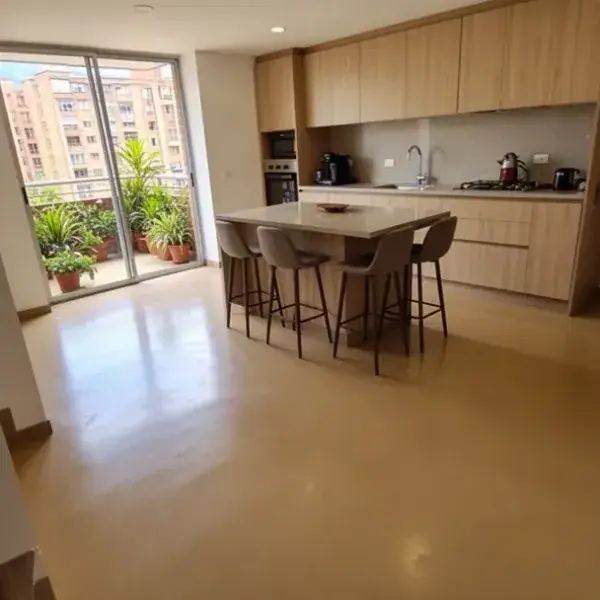
Drying times change with ambient humidity: in the rainy season a base coat can take twice as long to dry. Sealing microcement that is still damp leaves white stains that do not come out.
| Coat | Purpose | Drying time before the next |
|---|---|---|
| Bonding primer | Ties the system to the tile or mortar | 1 to 3 hours |
| First base coat with mesh | Embeds the fiberglass mesh and evens out the surface | 12 to 24 hours |
| Second base coat | Adds body and strength; sanded once dry | 12 to 24 hours |
| First finish coat | Sets the color and texture | 6 to 12 hours |
| Second finish coat | Closes the pores and defines the cloudy or smooth effect | 12 to 24 hours before sealing |
| Polyurethane sealer (2 to 3 coats) | Waterproofs the surface and protects it from stains | 24 hours between coats |
Sealed microcement repels water, but it is not waterproofing. In showers we first apply a flexible waterproof membrane on the floor and walls up to showerhead height, reinforced at corners and around the drain.
A shower needs a 1 to 2% slope toward the drain or linear grate; if it lacks one, we correct it with mortar before starting. Standing water eventually marks the sealer.
Where water is constant we use a two-component polyurethane sealer and neutral-cure silicone at joints with fixtures and glass. The shower stays out of use for the first 72 hours.
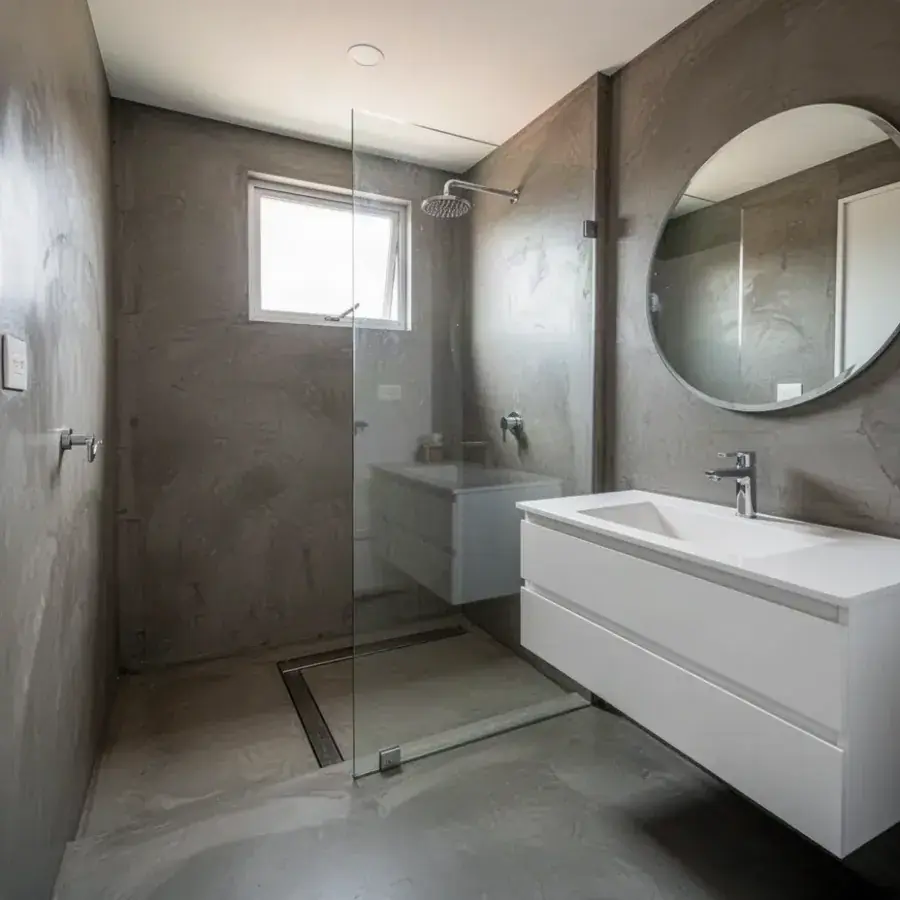
Grays, off-whites, sand, earth tones and soft greens or blues, tinted on site. We show samples on boards, because the dry color is lighter than the wet one.
The cloudy effect leaves soft trowel marks and tonal movement; smooth aims for an even tone. Smooth is more demanding and reveals any flaw in the base.
The sheen comes from the sealer, not the microcement. Matte hides scratches, while satin is a little easier to clean.
For showers, terraces and entryways we add an anti-slip additive to the sealer or use a coarser-grain finish.
Most of the cracked microcement we are called to inspect from other applicators fails because of the base, not the product. A hollow tile, a weak screed or a slab that is still moving passes its crack into a layer only 2 mm thick.
The usual culprits are loose tiles nobody detected, tile joints telegraphing through because no mesh was used, coats applied too thin to save material, and drying sped up by direct sun or fans.
Medellín is a seismic zone and tremors move building slabs. So we honor structural expansion joints with a profile instead of covering them; there is more on this in our guide to earthquakes and floors in Medellín.
If the base has active cracks or uneven areas, we fix it first through floor and subfloor repair and then apply the microcement.
A complete microcement system in Medellín costs COP $140,000 to $260,000 per m², including prep, mesh, coats and sealer. The exact price is confirmed at the site visit.
You can compare it with other finishes in our Medellín flooring price guide.
| Factor | Why the price changes |
|---|---|
| Base surface | Firm tile is quick; hollow tiles or a weak screed add repair work |
| Area | Below 15 to 20 m² the price per m² rises, since the coats and drying times stay the same |
| Bathrooms and showers | Waterproofing, slopes and detailing raise the cost per m² |
| Walls, stairs and vanities | More edges and corners, more labor |
| Color and finish | Bold colors and the smooth finish require tighter control |
| Sealer | Two-component polyurethane for water and traffic costs more than a one-component sealer |
Here is the typical schedule for a 60 to 80 m² apartment: 6 to 9 working days. Each bathroom with a shower adds one or two days for waterproofing.
We cover furniture and door frames, mallet-test the tiles, make repairs, sand and degrease.
We prime and apply the first base coat with the fiberglass mesh.
Second base coat, drying and sanding to leave the surface flat and free of ridges.
Two thin color coats with the agreed texture, lightly sanded in between.
Two or three coats of polyurethane sealer, 24 hours apart.
Light foot traffic after 48 to 72 hours, furniture after 7 days, and a signed completion record with a cleaning guide.
It can crack if the base moves, if it has no mesh or if it is applied too thin. On a firm base, with mesh and full coats, cracks are uncommon.
Over the years, hairline microcracks can appear from building movement, especially on large slabs, and they are repaired locally.
With a good sealer and residential use, more than 10 years. What wears is the sealer, not the microcement.
In high-traffic areas we recommend renewing the top sealer coat every 2 to 4 years, without touching the layers below.
With a satin sealer and no additive, it can be slippery when wet. In showers we always apply a matte sealer with an anti-slip additive that gives bare feet grip.
Yes, with exterior systems that have a higher resin content and a UV-resistant aliphatic sealer. On terraces above living spaces, waterproofing goes down first.
With the sun and rain of Eastern Antioquia, an exterior sealer needs maintenance more often than an interior one.
Use water, pH-neutral soap and a well-wrung mop. Avoid bleach, ammonia, acids and strong degreasers, which attack the sealer.
Send us photos of the floors or bathrooms, the approximate area and the color you have in mind, and we will book a free technical visit. At the visit we check the tile piece by piece, and your written quote arrives within 24 to 48 hours.
The microcement we apply carries a 1-year labor warranty; see what it covers on our warranty page.
Pisos Pro Medellín
Tv. 6 #45-115, El Poblado, Medellín, Antioquia, Colombia
Monday to Saturday: 7:00 a.m. to 9:00 p.m.
Sunday: 9:00 a.m. to 9:00 p.m.