Matte (200 to 400 grit)
Low reflection, hides scratches and is the safest choice where water is present. We recommend it for kitchens, entryways and areas where rain comes in.
Mechanical diamond polishing
At Pisos Pro Medellín we turn concrete slabs into polished concrete floors: we grind with diamonds, densify and take the surface to the sheen you choose. We have spent more than 15 years working only on floors, with over 900 finished jobs in Medellín and Eastern Antioquia.
We do it for retail stores, restaurants, lofts in Laureles and El Poblado, offices, showrooms and warehouses that want a durable floor with no coating to peel. Modern homes looking for a mineral finish without tile grout lines are a good fit too.
Polishing is not paint or an added layer: it is your own concrete, made harder and tighter. That means the result depends on the slab you already have, and assessing it is the first thing we do.
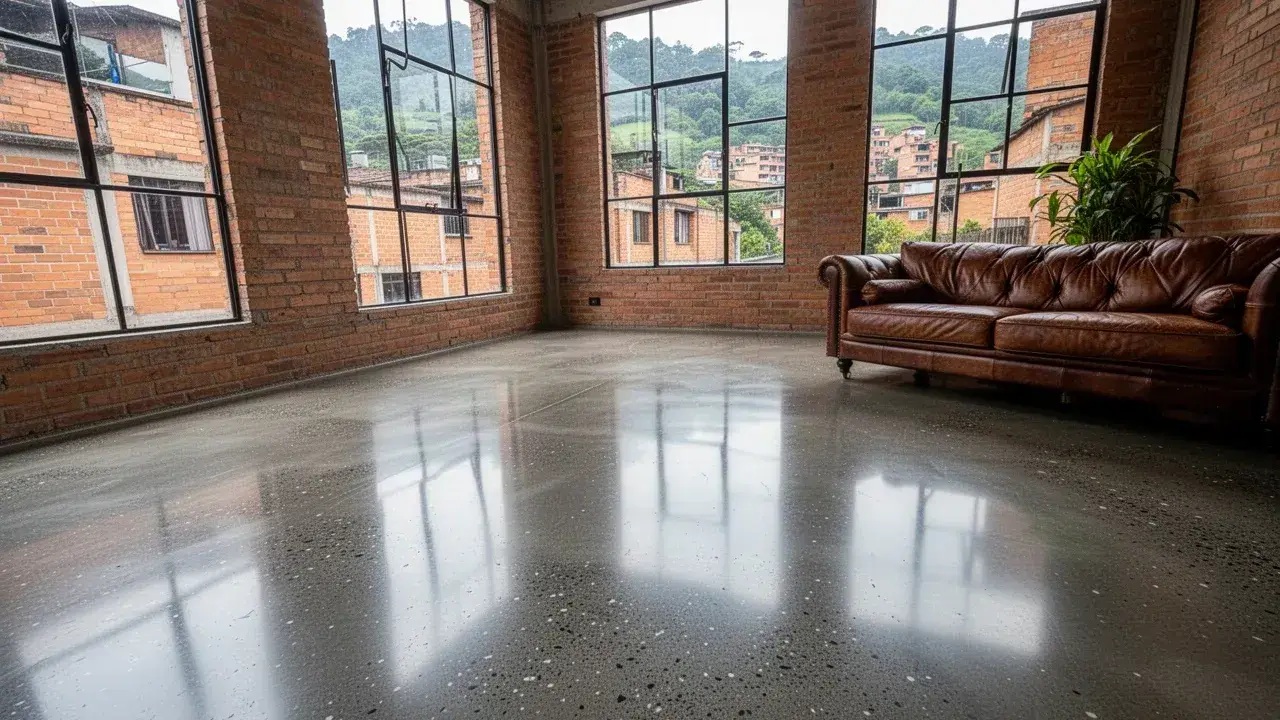
We work with planetary grinders and industrial vacuums with HEPA filters, dry or wet depending on the site. In stores that stay open during the job we prefer dry grinding with dust extraction, so the space does not fill with cement slurry.
The service includes slab assessment, grinding, crack and pore filling, densifying, progressive polishing, a protective guard and handover with maintenance instructions. On new slabs we coordinate with the builder so the concrete arrives fit for polishing.
If the slab does not exist yet, we pour it ourselves as part of our concrete flooring service, specified from day one for this finish.
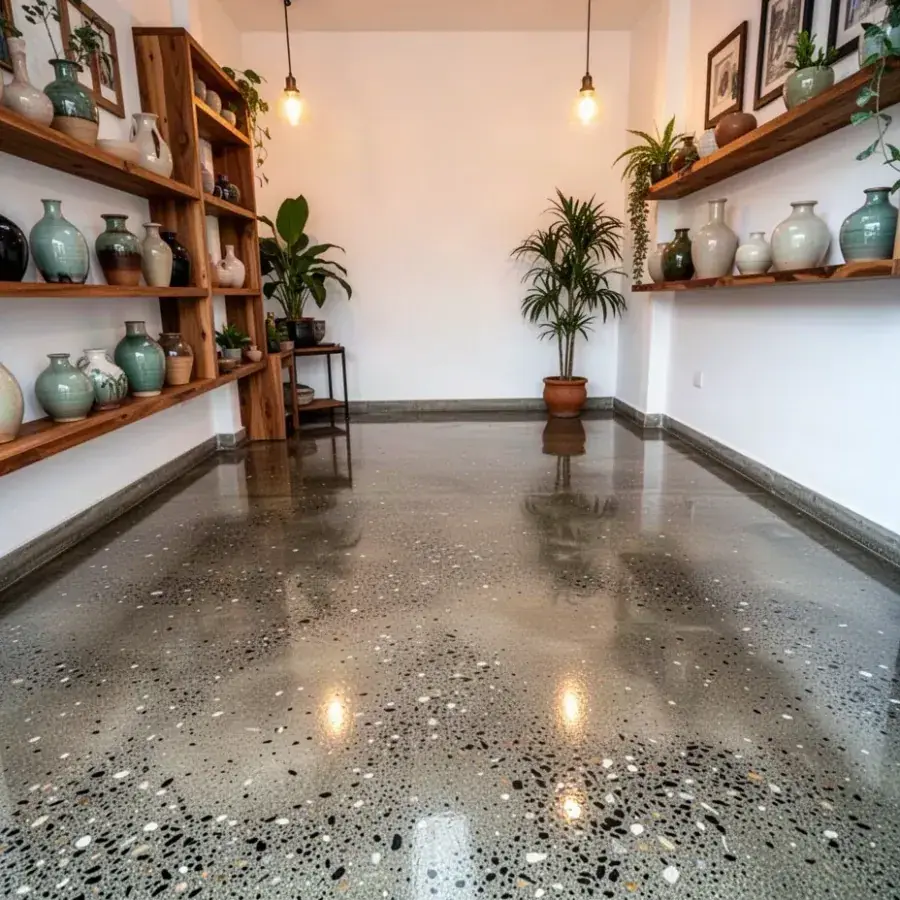
Many people ask for polished concrete in an apartment whose floor is a mortar screed, and that mortar rarely survives polishing. In those cases the right option is usually microcement, which achieves a similar look over any firm base.
| Feature | Polished concrete | Troweled cement (cemento afinado) | Microcement |
|---|---|---|---|
| Process | Mechanical diamond grinding and polishing of the slab | Mortar hand troweled, sometimes tinted | Thin coats applied by trowel |
| Thickness | Adds nothing; removes 1 to 6 mm | 2 to 4 cm of mortar | 2 to 3 mm |
| Look | Mineral, with visible aggregate depending on cut depth | Smooth, with trowel marks and blotches | Seamless, cloudy or smooth |
| Durability | Very high resistance to abrasion and heavy traffic | Medium; prone to cracking and dusting | Good for residential and light commercial traffic |
| Price per m² | COP $70,000 to $150,000 | Depends on mortar and area | COP $140,000 to $260,000 |
Low reflection, hides scratches and is the safest choice where water is present. We recommend it for kitchens, entryways and areas where rain comes in.
A soft sheen that looks clean without appearing wet. It is the most requested level for lofts, offices and restaurants.
A mirror effect for showrooms and storefronts. It demands a very flat slab, because the reflection highlights every wave.
Minimal grinding keeps the cement cream; removing 2 to 3 mm reveals fine sand, the salt and pepper look; deeper still, the full stone. Cut depth sets the look and cannot be undone.
Lithium silicate densifier reacts with the free lime in concrete and closes the pores with more calcium silicate hydrate. It hardens the surface, stops dusting and lets the diamonds bring up the shine; we apply it midway, between the resin grits.
A penetrating guard goes on last to resist oil, wine and coffee stains. It forms no film that can peel, but the floor is still concrete: an acid such as lime juice can etch it if left for hours.
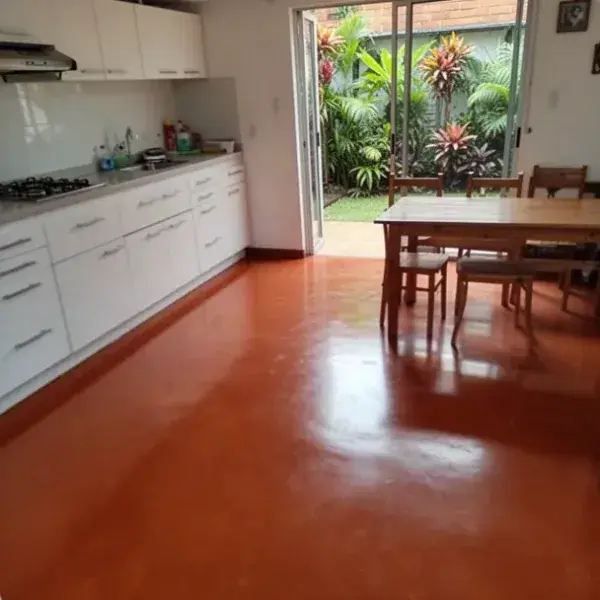
For colored polished concrete we use water-based or acetone-based dyes on the opened slab, or iron oxide pigments in the mix when the slab is new. Grays, earth tones and terracotta come out most even; bold colors vary with porosity, so we approve a sample on site.
Polishing brings the slab's history to light: shrinkage cracks, patches, trowel marks, oil that soaked in and mix differences between pours. Before starting, we walk the floor with you and mark everything visible.
Hairline cracks are filled with tinted epoxy or semi-rigid polyurea and polished flush; they remain as a thin line rather than vanishing. Control joints are cleaned out and filled with polyurea so wheels do not chip their edges.
A crack with an offset between its edges means the base is moving, and it is treated before polishing. If you want a fully uniform color with no veining or history, a coating such as epoxy flooring will suit you better.
Polished concrete in Medellín costs COP $70,000 to $150,000 per m² on an existing slab in good condition. The exact figure comes from the site visit and a test grind on a small area.
If you are comparing finishes, see our 2026 flooring price guide as well.
| Factor | Effect on price |
|---|---|
| Slab condition | Paint, tile adhesive or patches require more passes with coarse diamonds |
| Sheen level | Each extra grit is one more pass; high gloss costs more than matte |
| Aggregate exposure | Exposed aggregate needs deep grinding and wears more diamond tooling |
| Color | Dyes and pigments add material and a stage |
| Area and edges | Small rooms and many edges require a hand grinder |
An 80 m² store normally takes 3 to 5 working days. The slab must be at least 28 days old before we start.
We scratch-test hardness, check moisture, cracks and flatness, and grind a sample to see what aggregate appears.
Crosshatch passes with metal-bond segments at 30/40 grit, then 80 and 150, until the surface is opened evenly.
We mix resin with dust from the same concrete so the filler takes on its tone.
We apply the lithium silicate, let it react and remove the excess before moving on.
Resin pads at 100, 200 and 400 grit and, depending on the chosen sheen, 800, 1500 and 3000.
We apply the guard, burnish with a high-speed pad and hand over with a signed completion record and cleaning guide.
When dry, a matte or satin polish has good traction, comparable to many tiles. Wet or covered in fine dust, a high-gloss finish does become slippery.
In areas exposed to water we stop at 400 grit or apply a slip-resistant treatment, and we recommend mats at entrances.
Yes, if it is a strong slab with no hollow areas and enough thickness for grinding. Mortar screeds and lean concrete crumble and will not take a shine.
Leftover tile adhesive or paint is removed with coarse diamonds: it raises the cost but does not rule out the job.
Polish does not peel; the shine fades from grit carried in on shoes. In homes it holds for years with a microfiber mop and pH-neutral soap.
In high-traffic stores we recommend burnishing with a diamond-impregnated pad every few months and a light fine-grit repolish every 2 to 4 years, without repeating the grind.
Tell us the area, whether the slab is new or existing and the sheen you want; with photos we can often tell in advance whether it can be polished. The technical visit is free anywhere in the Aburrá Valley.
The work carries a 1-year labor warranty and is handed over with a signed completion record.
Pisos Pro Medellín
Tv. 6 #45-115, El Poblado, Medellín, Antioquia, Colombia
Monday to Saturday: 7:00 a.m. to 9:00 p.m.
Sunday: 9:00 a.m. to 9:00 p.m.