Technical flooring guide

Earthquakes and floors in Medellín: protecting your floor in a seismic zone

Pisos Pro Medellín is a flooring specialist that installs and repairs residential and commercial floors in Medellín, Envigado, Bello and Eastern Antioquia. For more than 15 years we have been detailing joints, adhesives and edge finishes so floors can move with the building instead of cracking.

Here we explain what happens to each type of floor during an earthquake, how it should be installed to cope, and how to tell a surface crack from a structural warning sign.

  • Based on the NSR-10 code
  • Flexible joints and adhesives
  • When to call an engineer
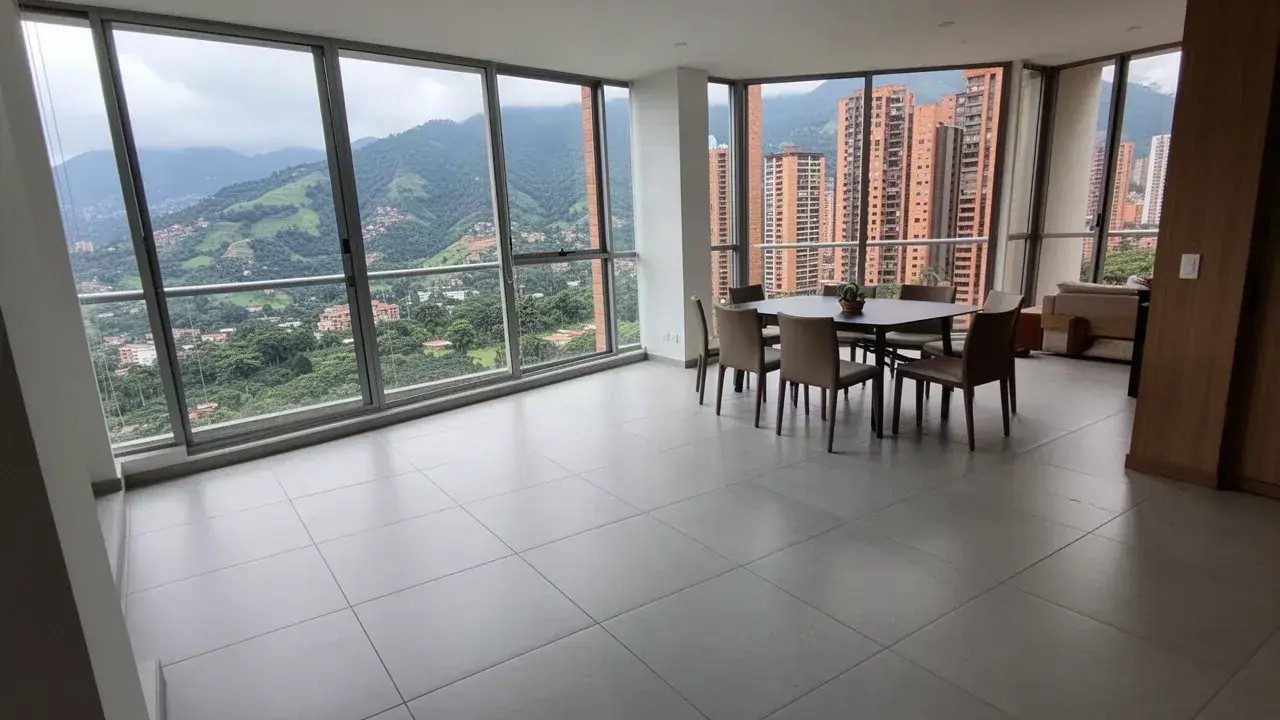
Large-format gray porcelain tile in a high-rise dining room

Where Medellín sits on Colombia's seismic map

Colombia's earthquake-resistant building code, the Reglamento Colombiano de Construcción Sismo Resistente (NSR-10), places Medellín in an intermediate seismic hazard zone. The Aburrá Valley also has seismic microzoning studies that adjust structural design to the soil in each sector.

The tremors (temblores) people feel in the city usually start far away, in regions such as Chocó, the Coffee Region or Santander. You can look up every recent event on the website of the Servicio Geológico Colombiano, the national geological survey.

For your floor, the practical consequence is that the slab and walls flex by a few millimeters with each quake. That movement, combined with concrete shrinkage and temperature swings, is what cracks a poorly detailed finish.
What happens to a floor when the building moves

The key difference is whether the floor is bonded to the slab or floats on top of it.

Bonded rigid floors

  • Porcelain tile, stone, terrazzo and microcement mirror every movement of the slab.
  • Without joints, stress builds up until tiles pop or cracks open.
  • Large tiles suffer more than small ones because there are fewer joints.
  • The classic symptom is a tile that sounds hollow or a crack that runs straight.

Floating floors

  • Laminate, SPC and floating engineered hardwood are not glued to the slab.
  • They absorb movement in the expansion gap around the perimeter.
  • They rarely break; at worst a seam opens or a transition strip shifts.
  • They fail when baseboards or heavy furniture pin down the expansion gap.

Movement joints and flexible tile adhesives

Perimeter joint

A gap of 5 to 10 mm is left against walls, columns and door frames, later hidden by the baseboard. Without it, the floor pushes against the structure and lifts or cracks at the corners.

Field joints

In large porcelain areas we cut joints and fill them with elastic sealant, typically every 25 to 36 m² indoors. They also go wherever the room changes shape, such as where a hallway opens into a living room.

Building structural joints

These are never bridged with continuous tiles. The floor is cut exactly over the joint and finished with an expansion joint profile that allows movement.

Deformable adhesives

For porcelain tile we use adhesives classified C2 S1 or S2, which accept small deformations without letting go. Brands such as Pegacor, Sika and Mapei offer lines like these, applied with double-buttering (adhesive on both the tile and the floor) so no voids are left.

Floors that handle movement best

If your building has recurring cracks, a floating floor such as SPC flooring is the most forgiving choice. If you prefer a stone-look finish, properly installed porcelain tile also works when it follows the details in this table.

Tolerance to slab movement, assuming correct installation.
FloorToleranceDetail that protects it
Floating SPC and laminateHighFree perimeter expansion gap and transition profiles at doorways
Floating engineered hardwoodHighExpansion gap and an underlayment that lets it slide
Glue-down vinyl (LVT)HighFlexible material; needs a slab without active cracks
CarpetHighNo special requirements
Small-format ceramic tileMediumMany grout joints spread the stress
Large-format porcelain tileLow to mediumC2 S1 adhesive, double-buttering and joints every few meters
Natural stone and marbleLow to mediumDeformable adhesive and joints filled with elastic sealant
Poured-in-place terrazzoLow to mediumDivider strips laid out in a grid
MicrocementLowReinforcing mesh and respecting the joints in the base
Polished concreteLowControl cuts made at the right time

A crack in the floor after a tremor: when to worry

Mark both ends of the crack with a pencil and write down the date. If it has not grown after two or three weeks, it is most likely damage to the finish only.

Surface crack in the finish

  • Cracked grout between tiles.
  • A single isolated tile that is split or hollow.
  • A hairline crack in microcement that keeps the same width.
  • An open seam in a floating floor.
  • Fixed with a minor repair (reparación locativa).

Possible structural damage

  • The crack runs straight across several tiles and continues up the wall.
  • A new step or height difference appears between tiles.
  • Diagonal cracks in walls or at the corners of doors and windows.
  • Doors that no longer close properly.
  • Cracks that get longer or wider from one week to the next.

When to call a structural engineer

If you notice any of the signs in the right-hand column, or cracks in exposed columns, beams or the slab, get a structural engineer's assessment first. Replacing the floor over an active problem only hides the evidence.

In an apartment building, notify building management (administración) so the board (consejo de administración) can arrange an inspection of common areas and the structure. If there is immediate danger, call the 123 emergency line.

Once you have the engineer's report, we repair the subfloor and the finish following their instructions.

Frequently asked questions about earthquakes and floors

Does a floating floor make the building safer?

No. A floor adds no seismic resistance; that depends on a structure designed under the NSR-10 code. What changes is how much the finish gets damaged and how much it costs to repair.

Does the installation warranty cover cracks caused by an earthquake?

Our 1-year workmanship warranty covers installation failures such as hollow tiles from poor adhesion or open seams. It does not cover damage caused by earthquakes or by structural settlement.

Let us inspect your floor after a tremor

We check for hollow tiles, joints and edge finishes, then tell you whether a floor and subfloor repair is enough or the area should be redone with proper joints. If the damage is in a seamless finish, we also assess your microcement.

Pisos Pro Medellín

Tv. 6 #45-115, El Poblado, Medellín, Antioquia, Colombia

info@pisosmedellin.com

Monday to Saturday: 7:00 a.m. to 9:00 p.m.

Sunday: 9:00 a.m. to 9:00 p.m.

Free quote